
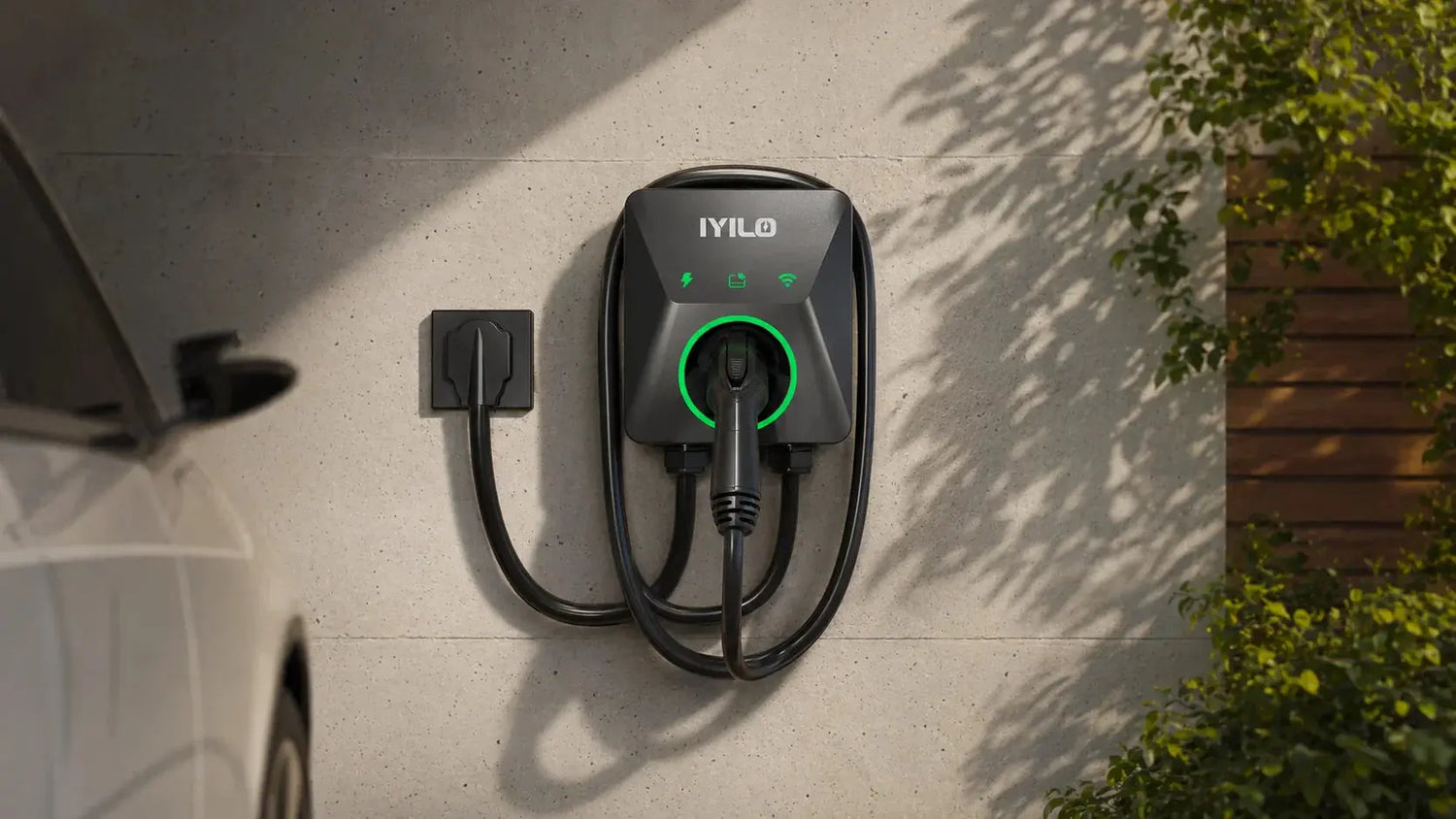
Installing a Level 2 EV charger has become the gold standard for home charging. Regardless of your daily mileage, a smart Level 2 charger offers the ultimate upgrade in convenience. While a basic Level 1 cordset may seem cost-effective for light drivers, the limitations of these slow chargers quickly become apparent. They often lack the intelligent features needed to manage energy costs and simply cannot provide the rapid recovery required when you're in a rush.
This comprehensive guide outlines essential installation standards, electrical specifications, and a rigorous safety checklist to ensure a high-performance, professional-grade charging solution.
1. Choosing Your Installation Form: Hardwired vs. Plug-In
Understanding the different Level 2 EV Charger installation types is essential before selecting the right EV charger. Since every home has a unique electrical configuration, this choice directly impacts both performance and convenience. Generally, home Level 2 chargers offer two distinct installation methods, each tailored to specific electrical scenarios and charging requirements.
Plug-In Installation
Plug-in installation utilizes a heavy-duty 240V NEMA plug designed to match standard high-power outlets. The most prevalent type is the NEMA 14-50, a versatile 4-prong outlet commonly used by high-performance home appliances like electric ranges and dryers. While older NEMA 6-50 outlets can still be found in some workshops or older homes, they have largely been phased out in modern EV charging due to their lack of a neutral wire. For long-term high-power loads, the NEMA 14-50 remains the gold standard for safety, reliability, and broad compatibility.


A standard NEMA 14-50 outlet typically delivers a robust 40 amps (9.6kW), providing approximately 35 miles of range per charging hour. This consistent, high-power performance is a testament to the IYILO brand. Our IYILO 40-Amp Plug-In version is perfectly tailored for customers looking for a high-performance charging solution that fits their existing NEMA 14-50 outlet.
Hardwired Installation
The hardwired installation option is the preferred choice for customers seeking a permanent and robust home charging setup. By wiring directly into the home's electrical panel, this method bypasses the need for outlet intermediaries, enabling a maximum power delivery of 48 amps (11.5 kW). As electric vehicles evolve, most modern models now feature high-current onboard chargers capable of accepting an 11.5kW input. Furthermore, a hardwired solution eliminates the risk of outlet melting, providing a safer and more reliable long-term charging experience.
IYILO provides a standard hardwired EV charger kit, complete with 6 AWG input wiring, flexible conduit, and all necessary fittings. For those seeking enhanced control, our Pro Version features an integrated Energy Meter for advanced Dynamic Load Management (DLM). This system automatically adjusts charging rates based on real-time household consumption—optimizing speeds during utility off-peak hours and preventing circuit overloads to significantly reduce electricity costs.
2. Essential Electrical Components and Specifications
Key Updates in NEC 2023 for EV Charging
In the 2023 edition of the National Electrical Code (NEC), there are several critical updates every homeowner should know:
1. GFCI Protection (NEC 625.54)
- Plug-in Installations: A GFCI circuit breaker is mandatory at the electrical panel for all plug-in chargers.
- Hardwired Installations: A GFCI breaker is NOT required at the panel because the IYILO charger features built-in CCID (Charge Circuit Interrupting Device) protection.
- The IYILO Advantage: Choosing the hardwired version can save you $100 or more by eliminating the need for an expensive GFCI breaker.
2. Energy Load Management (NEC 625.42(A) & (B))
NEC 2023 now explicitly supports Automatic Load Management Systems (ALMS), such as those found in the IYILO Pro Version.
The IYILO Advantage: Even if your home's total electrical capacity is limited, our dedicated Energy Meter can dynamically adjust charging currents. This allows you to legally install a high-power IYILO 48A charger without the massive expense of a main panel upgrade.
Circuit Breaker Sizing
Electrical codes mandate that Level 2 charger circuits must be sized at 125% of the continuous load. This rule applies whether you are installing a 40A plug-in model or a 48A hardwired unit. To satisfy this requirement, a properly rated circuit breaker is essential. While North American homes use single-pole (120V) breakers for standard outlets, a Level 2 EV charger requires a double-pole (240V) circuit breaker for a safe and compliant installation.
Commonly used circuit breaker brands include:
Important Reminder: Electrical panels are designed with unique internal architectures; therefore, circuit breakers are generally only compatible with their specific brand and series. To ensure a safe and proper fit, please verify your panel's brand and model before purchasing a circuit breaker.
Wire Gauge & Wire Type Requirements
For a hardwired or NEMA outlet level 2 charger installation, a licensed electrician is definitely required. Hiring an electrician is not only considered for safety and professional reasons, but also for code compliance.
In North America, wire type and gauge determine the maximum current capacity. Most electricians refer to NEC Code Table 310.16 for guidance. The IYILO 40A and 48A Level 2 EV chargers feature 6 AWG THHN input wiring—one of the most widely used wire types in professional Level 2 EV Charger installations.
Below are the most commonly utilized wire types for professional Level 2 EV Charger installations:
1. THHN/THWN-2 (Recommended)
- Application: Must be installed within a conduit (such as the Flexible Conduit included in our kit).
- Material: Single-core copper.
- Ampacity: Rated for 65A at a 75°C temperature rating.
- IYILO Recommendation: This is the superior choice for 48A hardwired installations. Its excellent heat dissipation fully satisfies the requirements of a 60A circuit.
2. NM-B Cable (Commonly Known as Romex)
- Application: Installed directly through wall studs without a conduit.
- NEC Limitation: Per NEC 334.80, NM-B cables must be rated based on the 60°C temperature column.
- Critical Drawback: Under the 60°C rating, 6 AWG NM-B is only rated for 55A.
- The Verdict: 6 AWG Romex cannot be used for 48A EV chargers because it fails to meet the 60A circuit requirement. If using Romex for a 48A load, you must upgrade to 4 AWG.
The Debate: Can 6 AWG Wire Handle a 60A Circuit?
There is often a debate among electricians regarding whether 6 AWG wire can safely support a 60A circuit (required for 48A EV charging). The definitive factor is Terminal Ratings under NEC 110.14(C). Even if your wire is rated for 90°C (such as THHN), if the terminals on the circuit breaker or the EV charger are only rated for 75°C, you must calculate ampacity based on the 75°C column.
6 AWG Copper (at 75°C): Ampacity is 65A. Since 65A > 60A (meeting the 48A × 125% requirement), using 6 AWG copper wire in conduit is fully compliant with electrical codes for a 48A charging installation.

3. Level 2 EV Charger Installation Process
Step 1: Assess Electrical Capacity
Before installation, verify that your main electrical panel can support the additional load. Older homes with 100-amp panels often require a service upgrade, as 100 amps are generally insufficient for high-current EV charging. While a 200-amp service—common in most homes—typically accommodates a Level 2 charger, it may still reach its limit if multiple high-power appliances are operating simultaneously.

A smart alternative to costly panel upgrades is installing a Dynamic Load Management (DLM) system, which balances electricity usage to prevent overloads. The IYILO Pro series is a perfect example of this technology, offering customers a cost-effective solution. Its integrated Energy Meter monitors total household power consumption in real-time, automatically adjusting the charging current to stay safely within your panel's capacity.

Step 2: Select Installation Location
Choose a mounting location that balances convenience, cable reach, and electrical access. Mount the charger where your EV parks regularly to minimize cable management issues and tripping hazards. For outdoor installations, ensure the location has adequate clearance from ground level to prevent water accumulation—IYILO chargers feature NEMA 4 waterproof ratings suitable for exterior mounting. Consider locations with good Wi-Fi signal strength, as IYILO chargers include smart connectivity features that require network access. Unlike some industrial chargers, residential Level 2 units do not require ventilation systems.
Step 3: Preparation & Required Tools
A professional hardwired installation requires specialized tools and materials to ensure a safe, code-compliant setup. Before beginning, ensure you have the following:
- Electrical Conduit & Fittings: 1-inch or 3/4-inch flexible liquid-tight conduit (depending on local code) and compatible connectors to protect the 6 AWG wiring.
- Installation Hardware: A bubble level to ensure the charging station and holster are perfectly aligned, a power drill, and wall anchors suited for your mounting surface.
- Safety & Precision Tools: A Torque Wrench is essential to tighten terminal connections to the manufacturer's specified values, preventing fire hazards from loose wires.
- Wire Strippers & Cutters: Heavy-duty tools rated for 6 AWG copper wiring.
Important Reminder: Secure all wire connections using a torque wrench. For the charger's internal terminals, tighten 6 AWG wires to the specified torque (typically around 22 lb-in / 2.5 N·m; please refer to the label on your unit for the exact value). For the 60A circuit breaker terminals, refer to the breaker manufacturer's specifications, which are commonly between 35–45 lb-in.
Step 4: Hardwiring Configurations
The hardwiring process typically follows one of two configurations, depending on the distance between your electrical panel and the charger:
Scenario A: Direct Panel Connection
If the charger is located near the main panel, the conduit is run directly from the panel to the IYILO charger's input port. The 6 AWG conductors (L1, L2, and Ground) are pulled through the conduit and terminated directly onto a dedicated 60A double-pole circuit breaker.
Scenario B: Connection via Junction Box
In cases where the charger is positioned further away, a junction box is often used. The main supply wires are run to the box, where they are spliced with the charger's input pigtails using high-quality wire nuts or Polaris connectors. This method provides more flexibility for complex wire routing.
Step 5: Install Circuit Breaker and Run Wiring
Turn off the power at the main breaker before beginning any panel work. Install the appropriately sized two-pole breaker in your electrical panel, ensuring proper connection to both hot bus bars. Run wire from the panel to the charger location using the appropriate conductor type for your installation. If using a junction box for the transition between conduit and the charger, ensure all connections are properly secured, and the box is rated for outdoor use if applicable.
Step 6: Mount the Charger
Securely mount your EV charger to a wall stud or appropriate backing at a comfortable height for cable access. The mounting surface must support the charger's weight plus cable management forces. For plug-in models, position the unit near the NEMA 14-50 outlet; for hardwired installations, coordinate mounting with wiring entry points.
Step 7: Make Electrical Connections
Proper connection torque is critical for safe operation and fire prevention. Wire terminal connections that are too loose create resistance, generate heat, and can cause fires; connections that are too tight can damage conductors or terminals. Use a torque screwdriver set to manufacturer specifications—IYILO and most Level 2 chargers specify 40–45 inch-pounds for connector terminals. For breaker connections, follow the breaker manufacturer's torque specifications, typically 30 inch-pounds for residential circuit breakers.
Step 8: Configure Charger Settings
IYILO chargers offer adjustable current from 6 to 48 amps via dip switches or the mobile app. Set the maximum current to match your electrical installation—for example, a 50-amp circuit supports 40-amp continuous charging. Configure Wi-Fi connectivity to enable smart features, including charging schedules, energy monitoring, and remote control.
4. Circuit Tripping Prevention
Frequent breaker trips indicate undersized circuits, incorrect current settings, or shared loads. Configure charger amperage to 80% maximum of circuit breaker rating—a 50-amp breaker supports 40-amp continuous charging. Verify dedicated circuits serve only the EV charger without other loads sharing the breaker. If tripping persists, confirm the wire gauge matches the breaker amperage and check for loose connections creating resistance.
Addressing Nuisance Tripping
Nuisance tripping refers to unexpected breaker trips that occur even when the circuit is not overloaded. Common causes include:
- GFCI Double-Protection: If you are using a plug-in model, avoid using a GFCI-type circuit breaker. Since the EV charger (like IYILO) already includes built-in CCID leak protection, "double-protecting" the circuit can cause the two systems to interfere, leading to nuisance trips. For hardwired installations, always use a standard (non-GFCI) breaker as per NEC 625.54.
- Electrical Noise: High-frequency interference from other large appliances on the same service panel can sometimes trigger sensitive breakers. Ensure all connections are torqued to spec to minimize electrical noise.
- Heat Sensitivity: If the breaker panel is exposed to direct sunlight or extreme heat, the thermal-magnetic breaker may trip prematurely. Ensure proper ventilation for the electrical panel.
5. IYILO Product Selection Guide
1. IYILO Level 2 EV Charger – 40A Plug-In (NEMA 14-50)
Price: Entry-level option
The 40A plug-in model represents IYILO's most accessible entry point for homeowners seeking reliable Level 2 charging without complex electrical modifications. This model plugs directly into a standard NEMA 14-50 outlet—the same 240-volt receptacle used for electric dryers—making installation straightforward and cost-effective.
Key Advantages:
- Plug-and-play simplicity: No hardwiring required; connects to existing or newly installed NEMA 14-50 outlets
- Delivers 40A maximum current: Provides 9.6 kW charging power, adding up to 38 miles of range per hour
- Dual NTC temperature sensors: Integrated sensors in both the NEMA 14-50 plug and J1772 connector monitor temperatures in real-time via the mobile app
- Factory-configured safety: Pre-set to 40A maximum output, complying with NEC regulations for plug-in chargers
- Portable potential: Can be relocated if you move homes, offering long-term flexibility
Best For: Homeowners with existing NEMA 14-50 outlets, renters who may relocate, or those seeking the simplest installation path without sacrificing charging performance.
2. IYILO Level 2 EV Charger – 48A Plug-In/Hardwired Dual-Mode (NEMA 14-50)
IYILO's 48A dual-mode charger stands out as the most versatile option in the lineup, offering unique convertibility between plug-in and hardwired configurations. This future-proof design protects your investment as electrical needs evolve.
Key Advantages:
- Dual installation modes: Operates at 40A when plugged into a NEMA 14-50 outlet; converts to 48A (11.5 kW) when hardwired with a conversion kit
- Maximum flexibility: Start as a plug-in today, upgrade to hardwired later without replacing the entire unit
- Full 48A capability when hardwired: Delivers 46 miles of range per hour at maximum power
- Adjustable current: Fine-tune charging from 6A to 48A in 1-amp increments via app or DIP switches
- Advanced temperature protection: Dual NTC sensors automatically reduce current to 32A when temperatures exceed 185°F, stopping charging entirely at 203°F
Best For: Homeowners uncertain about current electrical capacity who want maximum upgrade flexibility, or those planning future electrical panel upgrades but needing immediate charging solutions.
3. IYILO Level 2 EV Charger – 48A Hardwired
The dedicated 48A hardwired model delivers IYILO's maximum residential charging power through a permanent electrical panel connection. This configuration eliminates outlet intermediaries, enabling optimal power delivery and reliability.
Key Advantages:
- Maximum charging speed: Delivers full 48A (11.5 kW) continuously, providing up to 46 miles of range per hour
- Permanent installation: Direct connection to a 60A circuit breaker ensures stable, reliable power delivery
- Power-sharing capability: Supports dual-charger installations on a single circuit with automatic load balancing
- No outlet limitations: Bypasses NEMA 14-50's 40A plug-in restriction, accessing full circuit capacity
- Professional-grade reliability: Hardwired connections eliminate plug/outlet wear and connection resistance issues
Best For: Homeowners with adequate electrical panel capacity, those installing during home construction or major renovations, or multi-EV households requiring maximum charging speed.
4. IYILO Pro Level 2 EV Charger – 48A Hardwired with Energy Meter
The IYILO Pro represents the flagship model, integrating advanced Dynamic Load Management through its included energy meter and CT clamps. This intelligent system enables high-power charging even in homes with limited electrical headroom.
Key Advantages:
- Dynamic Load Management: Real-time monitoring of household electrical consumption automatically adjusts charging rates to prevent circuit overloads
- Includes energy meter (up to 200A) and CT clamps: Complete monitoring system included—no additional purchases required
- Avoid costly panel upgrades: Install 48A charging on existing electrical service by intelligently managing total household load
- Comprehensive energy tracking: Monitor charging costs, consumption patterns, and optimize Time-of-Use (TOU) utility rates through the app
- Multi-charger coordination: RS-485 communication enables sophisticated load balancing across multiple IYILO chargers
- Future-proof technology: OTA firmware updates ensure ongoing feature enhancements and optimization
Best For: Homes with limited electrical panel capacity (100A service or heavily loaded 200A panels), homeowners on time-of-use utility rates seeking cost optimization, or commercial/multi-family installations requiring advanced load management.
Conclusion
Professional Level 2 EV charger installation requires understanding electrical fundamentals, proper component sizing, and rigorous attention to safety protocols. By following established electrical codes, using calibrated torque tools, and selecting appropriately rated components, homeowners achieve safe, efficient charging systems providing years of reliable service. IYILO's versatile product lineup addresses diverse installation scenarios while delivering intelligent features that optimize performance and cost-effectiveness.
0 comments