
You bought an electric vehicle. You're excited. You call an electrician to install a Level 2 home charger — and the quote comes back with an unwelcome surprise: your 100-amp panel is maxed out. You need an upgrade. That's another $1,500 to $5,000 before you ever plug in your car.
This is one of the most common barriers to home EV charging in North America. Millions of homes, especially those built before the 1990s, simply weren't designed with the electrical headroom for a 40- to 48-amp EV charger sitting alongside an air conditioner, water heater, and electric dryer.
But here's what many EV owners don't realize: a panel upgrade isn't always necessary. Dynamic load balancing (DLB) is the technology that lets your EV charger operate at full capability without overloading your home's electrical system — and without touching your breaker box. In this guide, we'll explain exactly how it works, compare the leading DLB chargers on the market, and show how IYILO's energy meter bundle makes implementation straightforward.
Why Your Home Panel Can't Handle an EV Charger Without Dynamic Load Balancing
Most Level 2 EV chargers draw between 30 and 50 amps continuously. Under NEC Article 625 guidelines, a continuous-load device requires a dedicated breaker rated at 125% of its maximum draw — meaning a 48-amp charger needs a 60-amp circuit. On a modern 200-amp panel with open slots, that's straightforward. But consider a typical U.S. household's existing load:
- HVAC system: 30–60 amps
- Electric water heater: 20–30 amps
- Electric dryer: 30 amps
- Kitchen appliances and lighting: 20–40 amps
- Heat pump or EV charger (if dual-EV household): 30–60 amps more
Add a new 48-amp EV circuit and you can quickly approach — or exceed — your panel's safe operating limit. According to EnergySage, roughly 1 in 5 U.S. homes need some form of electrical upgrade before installing a Level 2 charger. For older homes with 100-amp service, that share climbs sharply.
The smarter alternative is technology that monitors your home's total electricity draw in real time and automatically adjusts the charger — so your panel never gets overloaded. That technology is dynamic load balancing.
What Is a Dynamic Load Balancing EV Charger — and How Does It Work?
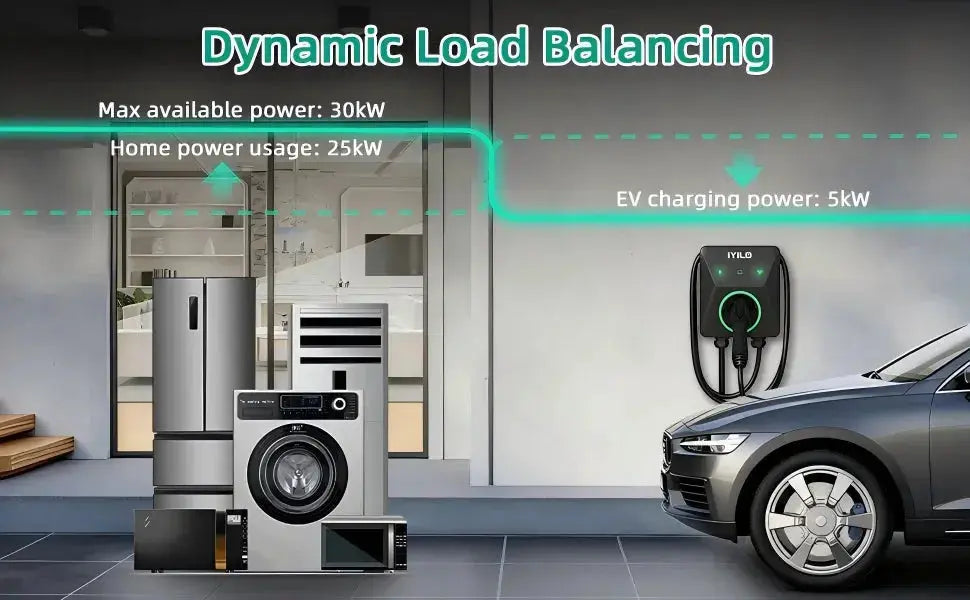
Dynamic load balancing (DLB) is a real-time power management feature that continuously measures how much electricity your home is consuming across all circuits, then automatically adjusts the current delivered to your EV charger to stay within your panel's safe limits.
Think of it like a smart throttle for your charger: when high-draw appliances kick in — the AC compressor starts, the oven preheats, the dryer runs a cycle — the DLB system detects the added load within seconds and reduces charging current. When those loads ease off, the charger ramps back up to maximum. This happens silently, in real time, with no manual intervention.
Does a Dynamic Load Balancing EV Charger Always Require an Energy Meter?
This is one of the most common questions about load balancing — and the answer depends on what kind of load management you want. There are actually two distinct features that can work independently or together:
- Power Sharing (two chargers sharing one circuit breaker) — does not require an energy meter. IYILO supports Power Sharing for up to 2 chargers on a single breaker, dividing available current between them. Emporia also supports power sharing across multiple chargers via its cloud platform, though as of early 2026, Emporia's DLB and power sharing cannot be used simultaneously in the U.S. Wallbox Pulsar Plus supports power sharing for up to 25 units using CAN bus wired communication between chargers.
- Whole-home DLB (Dynamic Load Balancing) — monitors the entire home's total current draw via CT clamps and an energy meter, and automatically throttles the charger to keep your panel within safe limits. This always requires an energy meter. IYILO, Emporia Pro, and Wallbox (via the Power Boost add-on) all support whole-home DLB.
- DLB + Power Sharing combined — when the home's total circuit capacity is constrained, IYILO can run DLB alongside Power Sharing. The energy meter monitors whole-home load, and the two chargers share the available current determined by DLB. This gives two-EV households the ability to charge both vehicles overnight even on a 100A panel.
Emporia's Vue 3 hub communicates with the charger via Wi-Fi, while IYILO uses RS-485 wired communication — a difference that matters for response speed and reliability (more on this below).
If your goal is to run a 48A charger on a constrained 100A panel, you need whole-home DLB — and that means an energy meter.
The Hardware Behind a Dynamic Load Balancing EV Charger: CT Clamps and Energy Meter
A whole-home DLB setup has two physical components:
- Current Transformer (CT) Clamps — These clip non-invasively onto the two main service conductors inside your breaker panel. They measure total current flowing into the home without interrupting power or requiring utility company involvement.
- An Energy Meter — This reads the CT clamp data and communicates in real time with the charger, instructing it to increase or decrease charging current as conditions change. Communication is typically via RS-485 cable (wired, low-latency) or, in some implementations, Wi-Fi (higher latency, less reliable for rapid throttling).
RS-485 vs. Wi-Fi: Why Communication Method Matters for Dynamic Load Balancing EV Chargers
Not all DLB systems communicate the same way between the energy meter and the charger — and the communication method has a direct impact on reliability and response speed:
- IYILO uses RS-485 wired communication between the energy meter and the charger. This provides millisecond response times, is completely unaffected by Wi-Fi congestion or router issues, and works reliably even in garages with poor wireless signal — including detached garages far from the home's router.
- Emporia Pro uses Wi-Fi between the Vue 3 energy monitor and the charger. If the Wi-Fi connection drops, the charger falls back to a minimum safe charging level set by the installer. Power rebalancing takes up to 30 seconds for load changes. Emporia's own documentation confirms this fallback behavior.
- Wallbox Pulsar Plus also uses RS-485 wired communication for its Power Boost (single-charger DLB) feature — similar to IYILO's approach. The RS-485 switch on the Pulsar Plus must be set to the "T" position, and a shielded STP Class 5E cable (up to 500m) connects the energy meter to the charger. Source: Wallbox Power Boost activation guide.
Key insight: For homes where the garage Wi-Fi signal is weak or unreliable, wired RS-485 communication provides more consistent DLB performance. This is especially relevant for detached garages or homes with mesh Wi-Fi systems — Wallbox has documented incompatibility with Fast Roaming (802.11r) networks, and any Wi-Fi-dependent DLB system faces the same fundamental limitation.
Dynamic Load Balancing EV Charger Comparison: Top Models in 2025–2026
Dynamic load balancing has become a competitive battleground among Level 2 home chargers. Here's how the major players approach it — and where the meaningful differences lie.
- Bundles Vue 3 Home Energy Monitor with two 200A CT sensors
- PowerSmart technology; adjusts in 1A steps
- Solar integration: charges from excess PV only
- J1772 + NACS versions available
- UL-listed; NEMA Type 4 enclosure
- App praised for granular data; UI can feel cluttered
- Up to 50A (12 kW) — highest output in class
- Manual current adjustment via app only — no CT clamps, no energy meter, no automatic real-time load throttling
- Best cold-weather cable; J1772 & NACS
- Deep app ecosystem; integrates with public ChargePoint network
- Future product architecture announced (April 2025) with DLB and bidirectional charging — not yet available
- Most compact form factor on the market
- Power Sharing among up to 25 units via CAN bus wired communication
- Whole-home DLB (Power Boost) via RS-485 wired energy meter — sold separately
- Alexa / Google Home compatible
- Energy meter and CT clamps not included — purchased as add-on
- Rugged IP67/NEMA 4 aluminum enclosure
- 40A only; DIP-switch current adjustment
- No CT-based whole-home load management
- OCPP 1.6J; strong outdoor performance
- Best choice for reliability over smart features
- Complete bundle: charger + energy meter + CT clamps
- RS-485 hardwired communication for low-latency response
- 48A hardwired (11.5 kW); real-time app monitoring
- Compatible with Power Sharing (two EVs, one circuit)
- ETL & Energy Star certified; dual NTC temperature sensors
- Highest-ever ChargerRater score (State of Charge review)
| Feature | IYILO Pro + Meter | Emporia Pro | ChargePoint Flex | Wallbox Pulsar+ | Grizzl-E Smart |
|---|---|---|---|---|---|
| Max output | 48A / 11.5 kW | 48A / 11.5 kW | 50A / 12 kW | 48A / 11.5 kW | 40A / 9.6 kW |
| Whole-home DLB | ✔ Included | ✔ Included | ✘ Not available | ⚠ Optional (Power Boost add-on) | ✘ None |
| DLB communication | RS-485 wired | Wi-Fi (Vue 3 hub) | N/A (no DLB) | RS-485 wired (Power Boost) | — |
| Energy meter included | ✔ Yes | ✔ Vue 3 | ✘ No | ✘ No (EMS extra) | ✘ No |
| CT clamps included | ✔ Yes (up to 200A) | ✔ 200A CTs | ✘ No | ✘ No | ✘ No |
| Plug-in + DLB | ✘ Hardwire only | ⚠ 40A plug-in (limited) | ✘ N/A (no DLB) | ✔ Yes | ✘ N/A |
| Power sharing (2 EVs) | ✔ Yes (up to 2 chargers) | ✔ Yes (via cloud) | ✘ No | ✔ Up to 25 units (CAN bus) | ✘ No |
| Solar integration | ✘ No | ✔ Yes (PV-only mode) | ✘ No | ✘ No | ✘ No |
| Dual NTC temp sensors | ✔ Yes (plug + connector) | ✘ No | ✘ No | ✘ No | ✘ No |
| Certification | ETL + Energy Star | UL-listed | UL-listed | UL-listed | ETL (UL 2594) |
| Bundle price | $599 | $599 | $549 (no DLB) | $649–699 (no meter) | $479 (no DLB) |
IYILO's Dynamic Load Balancing EV Charger Bundle: Ready Out of the Box
The IYILO Pro + Energy Meter bundle packages everything needed for a complete whole-home DLB installation into a single kit, available exclusively at iyilo.shop:
- 48A hardwired Level 2 charger — 11.5 kW output, up to 46 miles of range added per hour
- IYILO Energy Meter — supports standard split-phase panels up to 200A service
- CT clamps for measuring total home current on both main conductors (L1 + L2)
- 16-foot RS-485 communication cable (hardwired, low-latency connection)
- Dual NTC temperature sensors — plug end and connector end — with active thermal throttling
- ETL certification (UL 2594-compliant testing) and Energy Star rating
Once installed, the charger continuously monitors your home's power draw. If simultaneous loads push you toward your panel's limit, the system automatically lowers charging current in real time to prevent a breaker trip — allowing a 48A charger to operate safely on panels that would otherwise require an upgrade.
Step-by-Step: Installing IYILO's Dynamic Load Balancing EV Charger System
IYILO's official installation tutorial (embedded below) walks through the full process. Here's a structured summary of the key steps to help you prepare and have an informed conversation with your electrician.
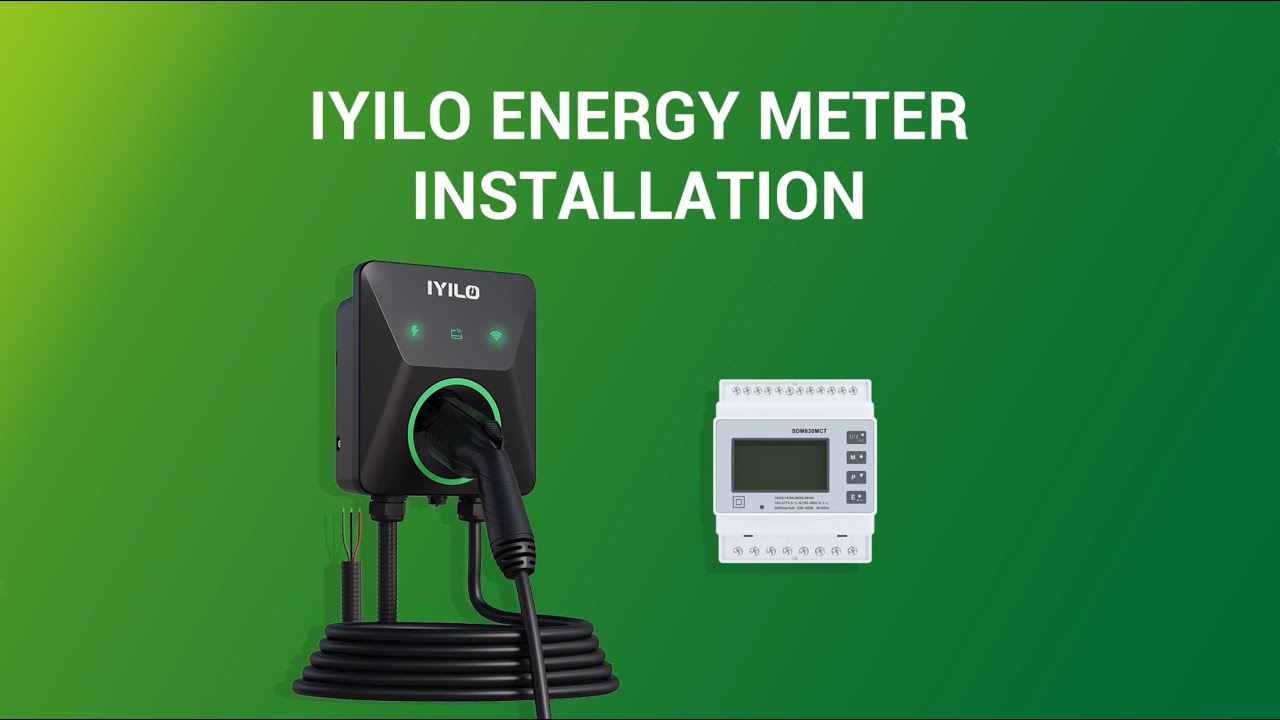
-
Mount the energy meter near your main panel The IYILO Energy Meter should be installed on or adjacent to your main breaker panel. It needs to be within reach of both the main service conductors (for CT clamps) and the 16-foot RS-485 cable run to the charger.
-
Clip CT clamps onto the main service conductors With power safely isolated, the licensed electrician clips one CT clamp each onto the L1 and L2 main service wires entering the panel. These clamps are non-invasive — they don't interrupt power or touch the wire insulation. No utility meter replacement is required.
-
Wire the energy meter and run the RS-485 cable The energy meter connects to a low-voltage power source inside the panel. The 16-foot RS-485 cable runs from the energy meter to the charger unit — this is the communication link that enables real-time load data exchange. The cable can be extended beyond 16 feet if the charger location requires it.
-
Hardwire the charger on a dedicated 60A circuit The IYILO Pro charger is hardwired directly to a dedicated 60A breaker. Unlike plug-in installation on a NEMA 14-50 outlet, hardwiring eliminates outlet derating concerns and maximizes the full 48A / 11.5 kW output.
-
Enable DLB in the IYILO App Open the IYILO App → Advanced → Load Balancing. The system automatically measures available current once the charger, energy meter, and RS-485 link are live. Enter the main breaker's amperage rating and DLB activates immediately. No manual calibration required.
What Installation Scenarios Is a Dynamic Load Balancing EV Charger Best Suited For?
- Attached garage, panel nearby: Ideal. The 16-foot RS-485 cable typically covers the run from a panel wall to a charger mounted in a standard single-car garage without extension.
- Older 100A panel home: Primary use case. DLB allows the charger to operate at maximum available speed without the panel upgrade expense.
- Two-EV households on a constrained panel: DLB combined with Power Sharing enables both chargers to charge overnight within safe limits.
- Detached garage or long cable runs: RS-485 cable can be extended, but longer runs add installation complexity. Discuss with your electrician before committing.
Who Actually Needs a Dynamic Load Balancing EV Charger?
| Your Situation | DLB Needed? | Recommended IYILO Option |
|---|---|---|
| 100A panel, already carrying significant load | ✔ Yes — high priority | Pro + Energy Meter ($599) |
| Electrician flagged insufficient headroom for 60A circuit | ✔ Yes | Pro + Energy Meter ($599) |
| Two EVs, one household, one constrained panel | ✔ Yes — DLB + Power Sharing | Two Pro bundles with shared DLB |
| 200A panel, several open breaker slots | ✘ Likely not needed | 48A Plug-In ($399) or 40A Plug-In ($369) |
| 200A panel + heavy simultaneous loads (heat pump, range, dryer) | ⚠ Consider DLB | Pro + Energy Meter for peace of mind |
| Renting or need plug-in flexibility | ✘ Not compatible with DLB | 40A Plug-In ($369) |
Dynamic Load Balancing EV Charger vs. Panel Upgrade: The Real Cost Comparison
Panel upgrades are consistently cited as the single largest barrier to home EV charging adoption in U.S. Department of Energy and utility company research. Here's an honest cost breakdown:
| Cost Category | Without DLB (Panel Upgrade Route) | With IYILO DLB Bundle |
|---|---|---|
| Charger hardware | $300–$700 (48A charger) | $599 (charger + energy meter + CTs included) |
| Panel upgrade (100A → 200A) | $1,500–$5,000+ | $0 |
| Electrician installation (charger only) | $200–$500 | $250–$600 (includes RS-485 routing) |
| Permit + inspection | $100–$300 + panel permit | $100–$300 |
| Utility coordination + wait time | 4–8 weeks typical | Not required |
| Estimated total | $2,100–$6,500+ | $950–$1,500 |
| Potential savings | — | $1,150–$5,000+ |
There is also a time savings dimension that doesn't show up in cost alone. Panel upgrades often require utility company coordination, multiple inspection visits, and permitting timelines that can stretch four to eight weeks in busy markets. A DLB-equipped charger installation adds only one extra wiring step — routing the RS-485 cable — to an otherwise standard job.
IYILO Pro + Energy Meter Bundle
Complete DLB system — charger, meter, CT clamps, RS-485 cable.
$599Why Dynamic Load Balancing Is Becoming a Must-Have EV Charger Feature
The U.S. EV market has crossed a significant threshold: according to the Alternative Fuels Data Center (AFDC), there are now more than 4 million registered electric vehicles in the United States, with the share of two-EV households growing rapidly. At the same time, the U.S. housing stock remains one of the oldest in the developed world — the median U.S. home was built in 1979, according to U.S. Census Bureau data, when 100-amp service was standard.
The collision of these two realities — aging electrical infrastructure and rapidly rising EV ownership — is what has pushed DLB from a niche feature to a mainstream consideration. InsideEVs noted in its 2025 best EV charger roundup that both power-sharing and dynamic load management have become key differentiators in the mid-to-upper-price charger segment.
The Emporia Pro's launch at $599 with a bundled energy monitor — and IYILO's matching price point with RS-485 wired communication — signals that the industry has found a market-validated price floor for all-in DLB packages. Wallbox, which charges separately for its Power Boost energy meter and CT clamps, faces competitive pressure to match this bundled approach. ChargePoint's current Home Flex lacks DLB entirely, though the company has announced future product architecture that will include it.
Dynamic Load Balancing EV Chargers and Older Homes
Customer sentiment research consistently identifies "works with older homes / constrained panels" as the top purchase driver for DLB-enabled chargers — ahead of speed, app features, or brand recognition. This aligns with the image you see highlighted in IYILO's own market research: good fit for constrained electrical capacity is the primary brand strength factor that DLB unlocks.
At the same time, honest disclosure matters: DLB does add installation complexity compared to a basic plug-in charger. The RS-485 hardwired connection is a meaningful step beyond plugging into a NEMA 14-50 outlet. Professional installation by a licensed electrician is not optional — it's required for safe, code-compliant operation. For buyers in newer homes with ample capacity, the IYILO 40A Plug-In remains the simpler, still highly capable alternative.
Dynamic Load Balancing EV Charger + Power Sharing: The Two-EV Solution
One of the most underappreciated aspects of IYILO's DLB implementation is its compatibility with Power Sharing. Power Sharing allows two IYILO chargers to operate simultaneously on a single circuit breaker without exceeding the breaker's capacity — the system automatically divides available current between the two units.
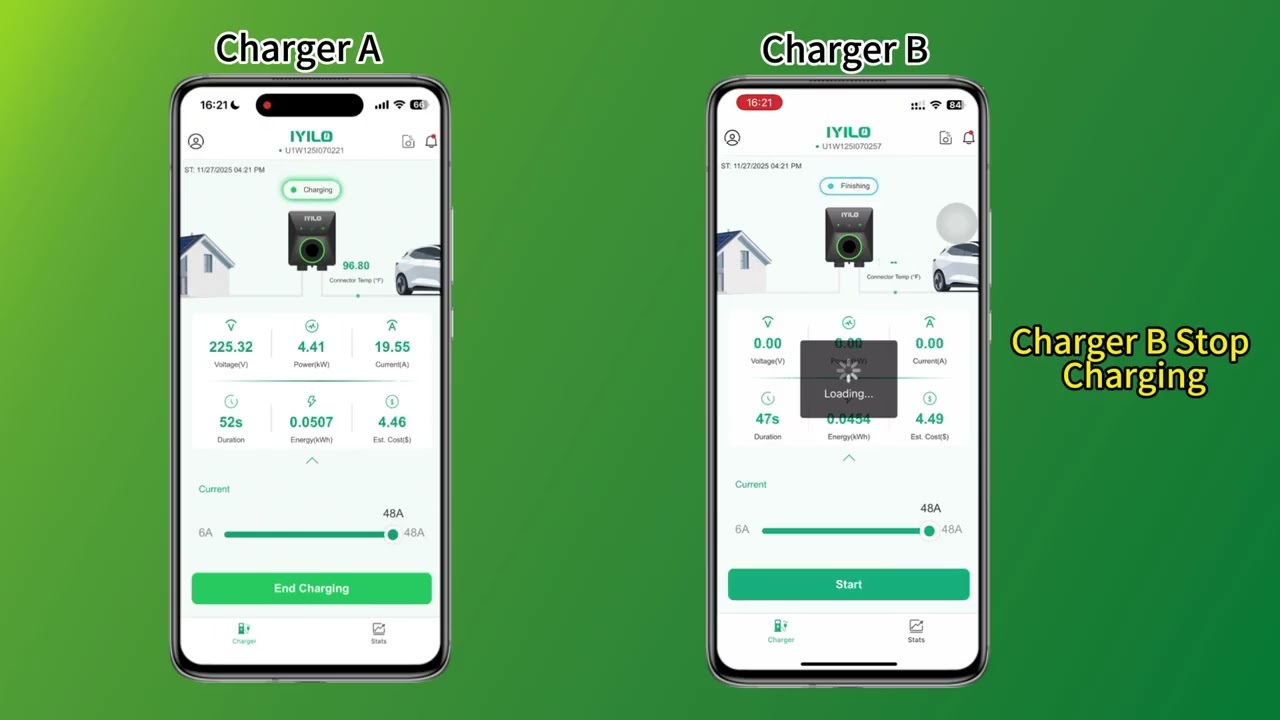
When DLB and Power Sharing work together, a two-EV household on a constrained 100A panel can charge both vehicles overnight with the system:
- Monitoring total home load via the energy meter
- Determining how much current is safely available for EV charging
- Dividing that available current between the two chargers in real time
This is a genuinely practical alternative to what was previously a $5,000+ proposition: a panel upgrade plus two dedicated 60A circuits. Many U.S. households will find that overnight DLB + Power Sharing charges both EVs adequately without either solution requiring more than their existing panel can safely handle.
The Bottom Line on Dynamic Load Balancing EV Chargers
For the millions of U.S. homeowners on older 100-amp panels, dynamic load balancing changes the home EV charging equation — not by bypassing electrical safety, but by making the charger smart enough to work within what your home already has.
Among all-in DLB bundles at the $599 price point, IYILO's Pro + Energy Meter package stands out for its RS-485 wired communication (lower latency than Wi-Fi alternatives), included CT clamps and energy meter, dual NTC temperature protection at both the plug and connector ends, and verified reliability backed by independent expert review. If you've been delaying home EV charging because of panel concerns, this is the solution worth a serious look.
Browse the full IYILO charger lineup to find the right fit for your home. And if you're still learning about EV charging safety, our guide to NTC temperature protection explains the other safety layer built into every IYILO charger.
Electrify your journey — without rebuilding your electrical system to do it.
Dynamic Load Balancing EV Charger FAQ
EnergySage — EV Charger Installation Cost Guide · U.S. DOE Alternative Fuels Data Center — EV Registration Statistics · NFPA 70 National Electrical Code (NEC Article 625) · InsideEVs — Best EV Chargers 2025 · EV Pulse — Emporia Pro Hands-On Review · State of Charge (Tom Moloughney) — Independent EV Charger Reviews · U.S. Census Bureau — Characteristics of New Housing · Emporia Help Center — Intelligent Load Sharing · Wallbox — How to Activate Power Boost (DLB) · ChargePoint Home Flex — Product Page
0 comments