
NACS vs. J1772: Why IYILO's New NACS Charger is the Safest Choice for Your Tesla in 2026
🚀 IYILO NACS Home Charger — Now Available for Pre-Order. Shipping begins ~April 15th. Visit Iyilo.shop to reserve yours.
Choosing a home charger for your Tesla in 2026 should be straightforward. It isn't — yet.
NACS (the North American Charging Standard) is rapidly becoming the universal EV connector in North America. Originally developed by Tesla, it's now being adopted by Ford, GM, Rivian, Honda, and virtually every other major automaker — meaning new non-Tesla EVs are increasingly rolling off the line with the same port your Tesla has always had. For home charging, that shift creates a real opportunity: a single NACS charger that works natively with your Tesla today, and with almost any EV you bring home in the future.
The benefits are straightforward — especially for households that already mix Tesla and non-Tesla vehicles. One NACS charger covers both cars. No second J1772 unit to install, no adapter to keep track of, no compromises. The same advantage extends to public charging: as NACS infrastructure expands across North America, non-Tesla drivers gain access to Tesla's Supercharger network for the first time — making every charging stop faster, simpler, and more consistent regardless of what you're driving.
But here's what most buyers overlook: choosing NACS over J1772 is only half the decision. The connector determines compatibility. The charger determines safety. And not all NACS chargers handle the safety side equally well.
Step 1: Why the Industry Is Moving from J1772 to NACS
J1772 has been North America's Level 2 AC charging standard since 2010. It works — but it was designed before the era of high-performance EVs, and it carries one structural limitation that ultimately drove the industry away: it cannot handle DC fast charging through the same port.
Tesla solved this a decade ago with a single compact connector handling both AC Level 2 and DC fast charging — what we now call NACS. For Tesla owners, that meant one port, one cable, and access to the entire Supercharger network. For non-Tesla EV owners on J1772, DC fast charging required a completely separate CCS1 port — a parallel infrastructure that never matched Tesla's network in reliability or coverage.
During 2024 and 2025, Ford, GM, Rivian, Honda, and virtually every other major automaker announced NACS adoption. The SAE formalized it as J3400 in September 2024. The data below shows why the pressure to switch was impossible to ignore:
US DC Fast-Charging Network Snapshot — January 2026
Source: State of Charge / AFDC, January 2026
| Network | Connector | US Ports | Market Share | Open to All EVs? |
|---|---|---|---|---|
| Tesla Supercharger | NACS (SAE J3400) only | 35,682 | 52.5% | ⅔+ of stations |
| Electrify America | CCS1 + some NACS | ~4,500 | ~6.6% | Yes |
| ChargePoint | CCS1 + some NACS | ~4,200 | ~6.2% | Yes |
| EVgo | CCS1 + CHAdeMO | ~3,800 | ~5.6% | Yes |
| All others combined | Mostly CCS1 | ~19,734 | ~29.1% | Yes |
| TOTAL (US) | — | ~67,916 | 100% | — |
The Supercharger network doesn't just lead in port count — it leads in deployment strategy. Stations are concentrated along interstate corridors, highway rest stops, and high-traffic convenience destinations, making them the default choice for long-distance travel.
The CCS1-to-NACS Adapter: A Transitional Workaround, Not a Solution
Many automakers have equipped existing CCS1-port vehicles with adapters for Supercharger access. It works — but with real limitations:
| Issue | With CCS1 + Adapter | With Native NACS Port |
|---|---|---|
| Compatibility | Varies — not all Supercharger stalls supported | Full access to all NACS-open stalls |
| Port position on car | May not reach stall; some vehicles occupy 2 stalls | Native fit — designed for the connector |
| Reliability | Extra mechanical connection point; adapter can loosen | Direct connection, no intermediary |
| Gen 1/2 Superchargers | Not compatible — older sites excluded | Compatible with all NACS-enabled sites |
| Long-term outlook | Transitional (small growth / remain current numbers) | Future-proof standard |
For Tesla owners, NACS isn't a new feature — it's the connector your car was designed around from day one. What's new is that the rest of the industry is now building to the same standard.
Step 2: NACS vs. J1772 — The Honest Technical Comparison
Here's a clear-eyed look at what actually differs between the two standards at the connector level:
| Feature | NACS (SAE J3400) | J1772 |
|---|---|---|
| Tesla Compatibility | Native — no adapter needed | Adapter required every session |
| Level 2 AC Charging | 9.6 kW (plug-in) / 11.5 kW (hardwired) | 9.6 kW (plug-in) / 11.5 kW (hardwired) |
| DC Fast Charging | Yes — same single connector | No — separate CCS1 port required |
| Connector Size & Weight | Compact & lightweight | Larger, bulkier handle |
| Daily Adapter Risk | None — direct connection | Daily insertion = wear point |
| Gen 1/2 Supercharger Access | Yes (with NACS port) | No — not supported |
| SAE Standard | SAE J3400 (2024) | SAE J1772 (2010, legacy) |
| Industry Direction | Adopted by all major automakers | Being phased out |
Important note: At Level 2 AC speed, NACS and J1772 are equivalent — both support the same circuit configurations. The IYILO plug-in version delivers 9.6 kW on a standard 40A / 240V NEMA 14-50 outlet (adding ~34 miles of range per hour; enough to fully replenish a Tesla Model 3 Long Range in under 11 hours). The hardwired version reaches 11.5 kW on a 60A circuit, reducing that same recharge to under 9 hours. The case for NACS at home isn't about charging faster — it's about removing the adapter, enabling single-port DC compatibility, and future-proofing for the vehicles your household will own.
So once you've settled on NACS — the right call for any Tesla owner in 2026 — the next question is the one most buyers never ask: is the charger itself safe for nightly use? That's where the real differences between products emerge.
Step 3: The Safety Gap Nobody Talks About
Switching from J1772 to NACS removes the adapter — one fewer mechanical connection, one fewer wear point. That's a genuine improvement. But it doesn't address the deeper safety risk in home EV charging: sustained high-current load at the physical connection points.
Where Home EV Charger Fires Actually Start

Home EV chargers are continuous-load devices — unlike a microwave or dryer that cycles on and off, an EV charger draws near-maximum current for 4–10 hours every night. This creates concentrated stress at three specific points:
| Risk Point | What Happens | Monitored by Most Chargers? | Monitored by IYILO? |
|---|---|---|---|
| Plug end (Wall outlet) |
Outlet contacts wear; wiring loosens over time. Resistance builds under sustained 40A load, generating heat at the connection. | ❌ No | ✅ Yes — NTC sensor |
| Connector end (Car port) |
Thousands of daily plug/unplug cycles + prolonged current flow create heat at the cable-to-vehicle interface. | ✅ Yes (some of them) | ✅ Yes — NTC sensor |
| Main unit (Wall box) |
The charger enclosure itself. Least likely to overheat — yet this is the only point most brands monitor. | ✅ Yes | ✅ Yes |
Step 4: Why IYILO's Dual NTC System Changes the Safety Equation
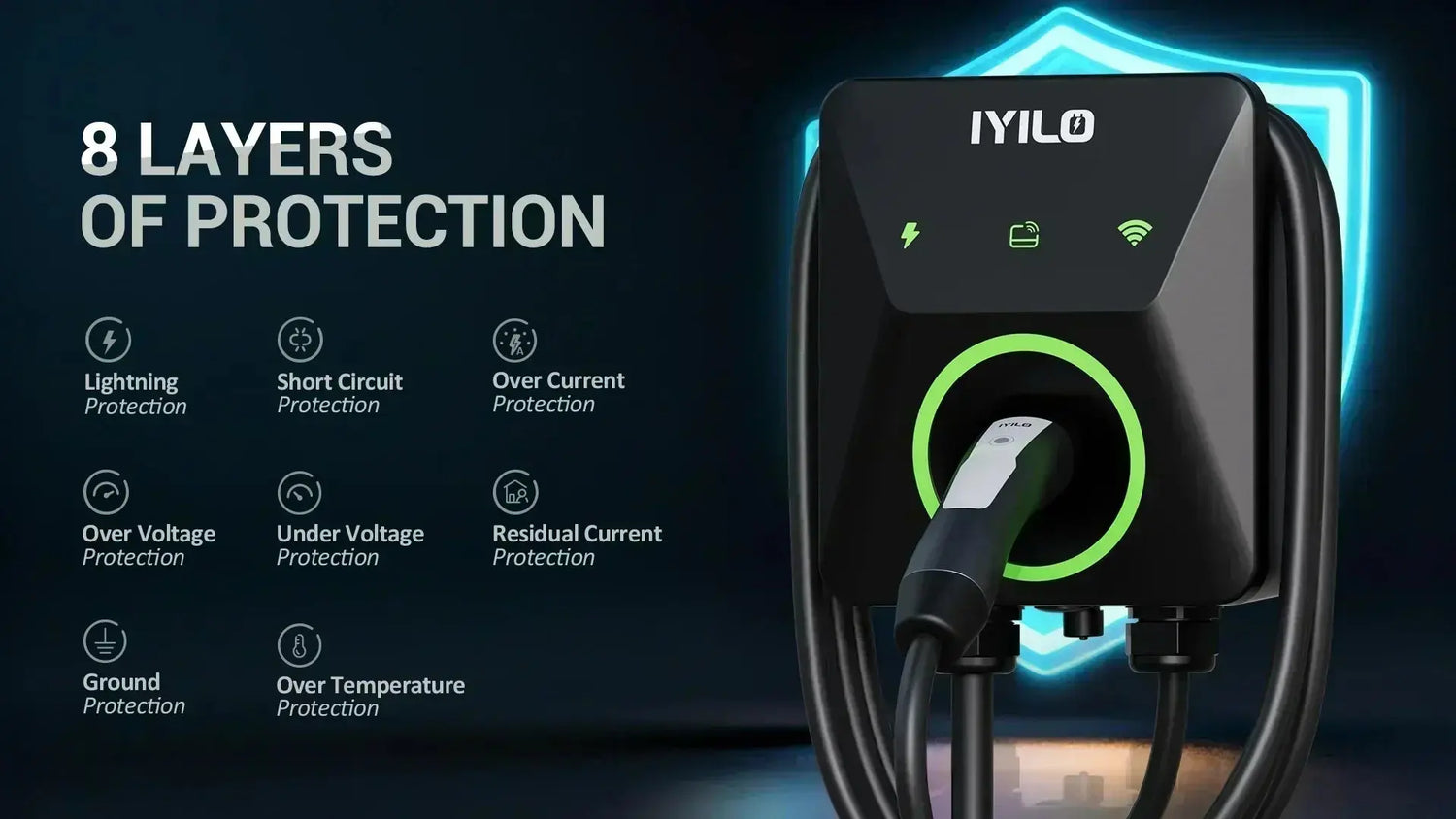
IYILO embeds high-precision NTC (Negative Temperature Coefficient) sensors at both the plug end and the connector end — the exact two points that most chargers leave unmonitored. The system doesn't wait for a problem to occur. It intervenes automatically to prevent one.
Active Thermal Throttling: How It Works
| Step | Trigger Condition | System Response | Outcome |
|---|---|---|---|
| 1 | Normal operation | Both NTC sensors monitor plug + connector end continuously | Full charging current maintained |
| 2 | Plug temp approaches 85°C | Control unit automatically reduces charging current (40A to 32A) | Heat generation decreases at source |
| 3 | Temp continues rising | Charging stops completely | Outlet and battery protected |
| 4 | Temp returns to safe range | Full current automatically restored (0A → 32A → 40A) | No manual reset required |
Most competitors monitor the main unit interior — the component least likely to overheat. IYILO monitors the plug end and connector end — the two points most likely to cause problems. That's the difference between a charger that reacts and one that prevents.
IYILO App: Real-Time and Historical Thermal Visibility
| Feature | Available Now | Coming May 2026 Update |
|---|---|---|
| Plug-end NTC temperature | ✅ Real-time display | ✅ 24-hour history graph |
| Connector-end NTC temperature | ✅ Real-time display | ✅ 24-hour history graph |
| Automatic throttle event log | ✅ Alert notifications | ✅ Full session history |
| Scheduled charging | ✅ Off-peak scheduling | ✅ Enhanced time-of-use |
| Electricity cost tracking | ✅ Per-session cost | ✅ Monthly trends |
| Dynamic load balancing | ✅ With meter version | ✅ Enhanced multi-vehicle |
| Remote start / stop | ✅ Full control | ✅ Full control |
Bonus: Dynamic Load Balancing for Multi-EV Households
For households with two EVs, IYILO's dynamic load balancing (meter version) avoids expensive panel upgrades by managing power distribution in real time:
| Scenario | Without Load Balancing | With IYILO Load Balancing |
|---|---|---|
| Two EVs charging simultaneously | Risk of tripped breaker or panel overload | Power shared dynamically — no overload |
| Panel at capacity | Requires $1,000–$3,000 panel upgrade | No upgrade needed — power redistributed |
| Dryer / oven running | Must manually unplug one EV | IYILO reduces EV draw automatically |
| Dryer finishes | Remains at reduced charge | Full EV capacity restored automatically |
Independent Validation: The Highest Score in State of Charge History
Claims about safety are easy to make. Independent reviews are harder to earn.
State of Charge — hosted by Tom Moloughney and regarded as the most authoritative EV charging review channel on YouTube — has reviewed virtually every major home EV charger on the market. IYILO earned the highest score in the channel's entire review history — surpassing well-established brands including ChargePoint and Wallbox. The dual NTC sensor system covering both the plug end and connector end was a key differentiator in that evaluation.
On certifications: leading competitors typically hold ETL or UL listing and Energy Star certification — so IYILO is meeting the same bar. Where IYILO stands apart is in the hardware-level safety features that certifications alone don't require: dual-endpoint NTC monitoring and active thermal throttling. These aren't certification checkboxes — they're engineering decisions that reflect a fundamentally different approach to charger safety.
IYILO NACS vs. Leading Competitors — Full Feature Comparison
| Feature | IYILO NACS | ChargePoint / Wallbox |
|---|---|---|
| NTC sensor — plug end (wall outlet) | ✅ Monitored | ❌ Not monitored by most brands |
| NTC sensor — connector end (car port) | ✅ Monitored | ❌ Not monitored by most brands |
| Auto current reduction on overheat | ✅ Active thermal throttling | ⚠️ Limited or absent on most models |
| Max output — plug-in version | 9.6 kW (40A / NEMA 14-50) | 9.6 kW (comparable) |
| Max output — hardwired version | 11.5 kW (60A circuit) | 11.5 kW (comparable) |
| App: 24-hr temp history | ✅ Coming May 2026 | ❌ Not available |
| Native NACS connector | ✅ Yes | ✅ Available on newer models |
| State of Charge score | ✅ Highest score in SOC history | ✅ Reviewed — at high scores |
| ETL / UL certification | ✅ ETL (UL compliance) | ✅ ETL or UL (some have full UL) |
| Energy Star certified | ✅ Yes | ✅ Yes (most models) |
Frequently Asked Questions
Is NACS the same as Tesla's charging connector?
Yes. NACS (North American Charging Standard) is Tesla's original connector, now formalized as SAE J3400 in September 2024. Tesla has used it across all its vehicles since 2012. Starting in 2023–2024, Ford, GM, Rivian, Honda, and other automakers adopted NACS as their native port — making what was once a Tesla-exclusive standard the universal EV charging connector for North America.
Do I need to replace my home charger if I already have a J1772 setup?
Not immediately — a J1772 charger will still charge your Tesla with an adapter. But if your charger is aging or you're buying new, upgrading to native NACS makes practical sense: it removes the daily adapter (one fewer wear point), enables full native vehicle-charger communication, and ensures compatibility with any NACS-native EV added to your garage.
What is the difference between a 9.6 kW and 11.5 kW home EV charger?
Installation type determines maximum output. A plug-in Level 2 charger connects to a NEMA 14-50 outlet (240V, 40A circuit) and delivers up to 9.6 kW — adding approximately 34 miles of range per hour, enough to fully replenish a Tesla Model 3 Long Range (358-mile EPA range) in under 11 hours. A hardwired charger on a 60A circuit delivers up to 11.5 kW — cutting that recharge to under 9 hours. For most Tesla models, 9.6 kW is more than sufficient for overnight charging. The hardwired version benefits Cybertruck owners, large-pack Model S/X owners, or households with higher daily driving needs.
How does automatic current reduction (thermal throttling) protect my home?
When an EV charger draws 40A continuously for hours, heat builds at the physical connection points — especially where the plug meets the wall outlet. Loose wiring or worn outlet contacts increase resistance, which increases heat. If unchecked, this can damage the outlet or cause a fire. Automatic current reduction places NTC temperature sensors at these high-risk endpoints. When a sensor detects temperatures approaching a critical threshold, the charger reduces current output — lowering heat at the source before it becomes hazardous. IYILO implements this at both the plug end and connector end, stops charging entirely if temperatures continue rising, and resumes automatically once safe levels are restored.
Can a NACS home charger work with non-Tesla EVs?
Yes — and the list of compatible vehicles is growing. Rivian and Kia are among the first non-Tesla brands to ship vehicles with factory-native NACS ports in 2025–2026, with Ford, GM, Honda, and others rolling out native NACS models progressively through 2026 and beyond. For existing EVs with J1772 or CCS1 ports, a manufacturer-supplied adapter maintains access. Buying a NACS home charger today means investing in infrastructure that will natively cover the full range of EVs entering the North American market over the next several years.
Is a Level 2 EV charger eligible for tax credits or utility rebates?
In many cases, yes. The US federal IRS Form 8911 provides an Alternative Fuel Vehicle Refueling Property Credit that has historically covered residential EV charger installation. Many state utility programs also offer $50–$500 rebates on Energy Star-certified Level 2 chargers — including programs in California, New York, and Colorado. IYILO holds Energy Star certification and is pursuing EPRI listing to expand eligibility further. Always verify current requirements with your local utility and a tax professional.
The Verdict: NACS Is the Right Connector. IYILO Makes It the Safest Charger.
NACS replaces J1772 for the right reasons — it's Tesla's native standard, handles both AC and DC through a single port, and eliminates the adapter that was always a small but real liability. For Tesla owners in 2026, a NACS home charger is the correct choice.
But the connector is just the beginning. The safest home charging experience comes from a charger that actively monitors the two most vulnerable points in the circuit, intervenes automatically when heat builds, and gives you complete visibility into every session through the app. That's what IYILO was built to do — and why State of Charge gave it a score no other home charger has matched.
The IYILO NACS charger is now available for pre-order, with shipping beginning around April 15th. Visit iyilo.shop to reserve yours. Electrify your journey.
0 comments