
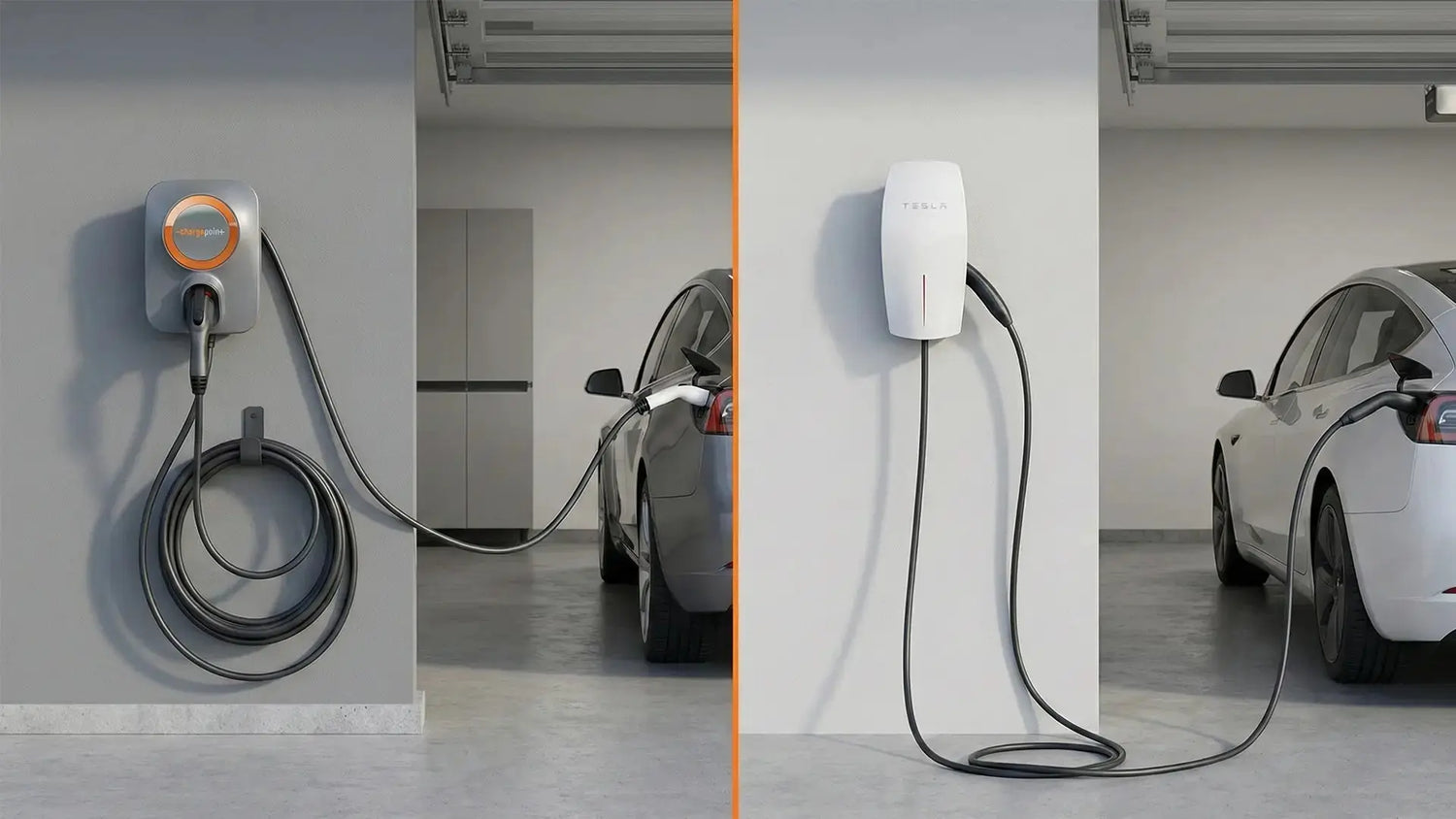
If you are currently researching home EV chargers, your browser tabs probably tell a familiar story. You have the Tesla Wall Connector on one side and the ChargePoint Home Flex on the other.
It makes sense. These are the two loudest names in the room.
In the 2024 market, the gap between "brand name" and high-performance independent chargers has vanished: you can get the same speed, the same safety certifications, and greater flexibility for hundreds of dollars less—making brand differences less relevant than ever, despite common searches like "ChargePoint vs Tesla charger."
Having analysed charging infrastructure for years, I’ve seen the landscape evolve. While Tesla Wall Connector and ChargePoint Home Flex were once the default choices, there is now a compelling new option: the IYILO EV Charger, which may offer you the best value on the market. Let’s break down the pros and cons of the two giants before diving into why IYILO might be your smartest pick.

The Tesla Wall Connector: The "Walled Garden" King
Let’s start with Tesla. For a long time, this was the default choice, and for good reason. It’s sleek, it’s reliable, and it integrates perfectly with the Tesla ecosystem.
The Pros:
- Price: Surprisingly, Tesla is often cheaper than ChargePoint.
- Integration: If you own a Model Y or Model 3, the button on the handle opens your charge port. It’s a small detail, but a nice one.
- NACS Native: No adapters needed for Tesla vehicles.
The Cons (And they are big ones):
- Connector Headache: For Ford, Rivian, Hyundai, or VW owners, using the standard Tesla Wall Connector requires an adapter every time you charge. (Note: a Universal version exists, but it is much more expensive.)
- Installation: Most Tesla Wall Connectors require professional installation—they do not include a plug for direct connection to a dryer outlet (NEMA 14-50).
- Short Cable: The standard cable is often 24 feet, sometimes shorter, depending on the version.

The ChargePoint Home Flex: The Premium Heavyweight
ChargePoint leads public charging, and its home charger is built to match that reputation. However, you pay a premium for the brand.
- Flexibility: Can be plugged in or hardwired, giving owners options for installation.
- The App: Their app is polished and integrates with their public charging network.
- Cold Weather: Their cable is known for staying flexible in freezing temps.
The Cons:
- The "Apple Tax": You are paying for the logo. The ChargePoint Home Flex often retails for $200 to $300 more than comparable units.
- The Same Specs: Despite the high price tag, it doesn't actually charge your car any faster than other 48A or 50A chargers. You are paying for the brand, not extra miles per hour.

The Smart Alternative: Why IYILO Wins on Value
Now, look at the IYILO Level 2 EV Charger.
Stripped of branding and marketing, the IYILO charger emerges as the standout choice. It matches ChargePoint in flexibility and Tesla in price, delivering you the advantages of both—without restricting you to a single ecosystem. This strong value proposition is why IYILO increasingly dominates smart shoppers’ shortlists.
Key reasons buyers choose IYILO:
1. Plug or Hardwire Flexibility (Improves on Tesla)
Remember how the standard Tesla charger forces you to hardwire? The IYILO EV Charger gives you a choice right out of the box. It comes with a NEMA 14-50 plug pre-installed. If you have a 240V outlet, you can install it yourself in five minutes. No electrician required. But, if you want maximum power later, the IYILO is convertible. You can remove the plug, hardwire it, and flip a switch to unlock the full 48A (11.5kW) speed. You get the easy installation today and the upgrade path for tomorrow.
2. Universal Compatibility (J1772 Standard)
Unlike the standard Tesla Wall Connector, the IYILO uses the J1772 connector. This is the universal standard for North America. It fits every Ford Mustang Mach-E, Chevrolet Bolt, Hyundai Ioniq 5, Kia EV6, and Rivian. "But I have a Tesla!" No problem. Your Tesla came with a J1772 adapter in the glovebox. You can use the IYILO charger just as easily as a Tesla charger. This makes IYILO the better choice for households with mixed vehicles (e.g., one Tesla and one VW).
3. Safety Without the Markup
A common fear is that "cheaper" means "unsafe." This is where you need to look at certifications. Like ChargePoint, the IYILO charger is ETL-certified. It has passed the same rigorous safety tests. It features a NEMA 4 enclosure, meaning it is fully weatherproof (rain, snow, dust) for outdoor installation. You aren't paying less because it's safer; you're paying less because IYILO isn't spending millions on Super Bowl ads.
4. Smart Features that Actually Save Money
Both Tesla and ChargePoint talk a lot about their apps. But what do you actually need an app to do? You need it to schedule charging so you only use electricity when it's cheap (off-peak hours). The IYILO App handles this perfectly. You can set schedules, monitor your energy consumption (kWh), and track your costs. It connects via Wi-Fi, putting total control in your pocket. Why pay an extra $300 for a ChargePoint unit just to do the exact same scheduling?
The Verdict: Which Charger Should You Buy?
When we look at the chargepoint vs Tesla charger debate, the answer depends on who you are.
- Buy the Tesla Wall Connector if you own a Tesla, plan to own only Teslas forever, and are okay with paying an electrician for an immediate hardwired installation.
- Buy the ChargePoint Home Flex if: Budget is not a concern for you, and you want the absolute premium brand name on your wall, regardless of the cost.
Buy the IYILO EV Charger if: You want the best ROI (Return on Investment). You want a charger that can plug in now (40A) but upgrade to hardwired speed later (48A). You want a unit that works natively with every non-Tesla EV but still supports your Tesla with an adapter. You want ETL-certified safety without paying the "brand tax."
In the world of EV charging, electricity is electricity. Your car doesn't know if the electrons are coming from a $750 unit or a $400 unit. It only cares about speed and reliability. The IYILO delivers both, leaving you with extra cash in your pocket—maybe enough to pay for a few years of charging.
Ready to make the smart switch? Discover the IYILO 48A/40A Convertible Charger here and stop overpaying for a logo.
0 comments