
Understanding the SAE J1772 Charging Adapter: Essential Guide for EV Owners
If you have just purchased your first electric vehicle, welcome to the club. You have left behind oil changes and gas stations, but you have likely walked into a confusing new world of acronyms. You hear about CCS, NACS, CHAdeMO, and Level 2 charging.
But there is one alphanumeric code you will see more than any other: SAE J1772.
Often just called the "J-Plug," this connector is the unsung hero of the electric vehicle revolution. For over a decade, it has been the universal language allowing nearly every EV to connect with the power grid. Whether you drive a Ford Mustang Mach-E, a Rivian, or a Tesla Model Y, understanding the SAE J1772 charging ecosystem is critical to daily life.
In this comprehensive guide, we will strip away the engineering jargon. First, let's explore what this plug actually does. Then, we'll discuss why it matters, how to use it safely, and finally, how it bridges the gap between different car brands.

Introduction to SAE J1772
To understand why this plug looks the way it does, we have to look back at the "Wild West" of early electric cars. In the 1990s and early 2000s, charging an EV was a nightmare. Some cars used paddles (like the GM EV1), some used rectangular plugs, and others used industrial connectors that looked like they belonged on a welding machine.
There was no standard. If you drove your car to a friend’s house in the next city, you couldn't guarantee you could plug it in.
What is SAE J1772?
SAE J1772 is the North American standard for electric vehicle electrical connectors. It is maintained by the SAE International (formerly the Society of Automotive Engineers).
Think of it as the USB port for cars. Just as USB became the standard for connecting mice, keyboards, and printers to computers, J1772 became the standard for connecting cars to the electrical grid.
The J1772 standard specifies the connector's physical shape, electrical specs, communication protocol, and safety requirements. In everyday use, "J1772" usually refers to the plug itself.
J1772 handles AC charging: Level 1 (120V outlet) and Level 2 (240V outlet or station) for faster charging.
- Level 2 Charging: Plugging into a 240V outlet (like a dryer outlet) or a hardwired station for much faster speeds.
Note: J1772 does not support DC Fast Charging. That needs a CCS plug, which adds two pins below the J1772 core.
Importance of J1772 Standard
Why should you care about a plastic handle? Because without this standard, public charging would be impossible.
- Safety First: The SAE J1772 connector isn't just a fancy extension cord. It’s a communication device. It has safety protocols built in that prevent electricity from flowing until the plug is securely locked into the car. You could drop a live J1772 plug into a puddle of water, and nothing would happen because the power isn't "live" until the handshake with the car is complete.
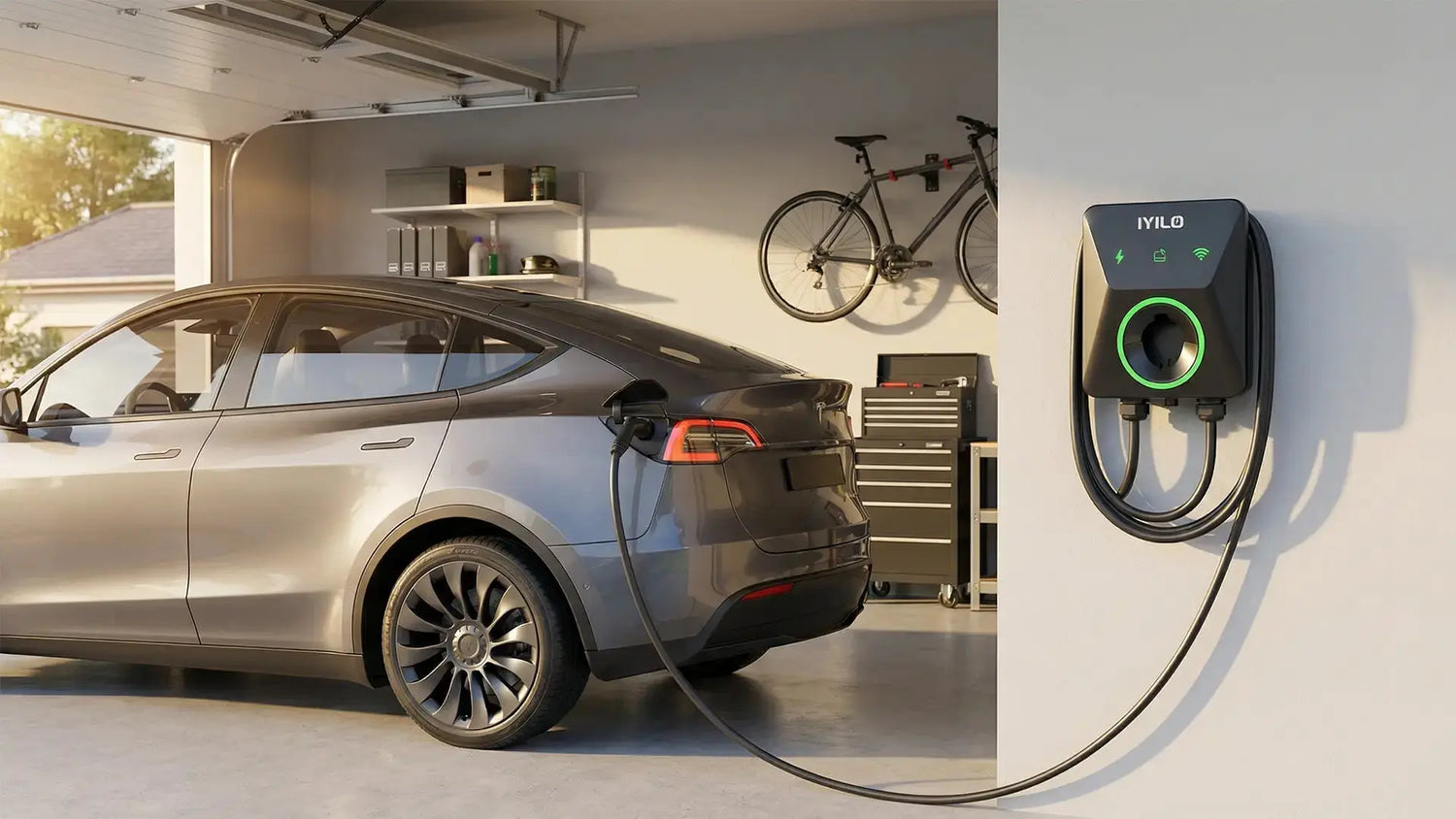
- Interoperability: Because of this standard, you can buy an IYILO Level 2 charger and know it will charge a Chevy Bolt, a Jeep Wrangler 4xe, and a BMW i4 equally well.
- The Tesla Bridge: Even though Tesla uses its own proprietary plug (now called NACS), the J1772 standard is so vital that every Tesla comes with a J1772 adapter. This allows Tesla drivers to use the extensive network of non-Tesla charging stations at hotels, workplaces, and shopping malls.

The J1772 Charging Adapter
When people search for "adapter" in the EV world, they are usually looking for a bridge between two different worlds: The Universal World (J1772) and the Proprietary World (Tesla).
Overview of J1772 Adapter
An adapter is a physical converter that changes a plug's shape to fit a different port. It passes electricity through without altering voltage or amperage.
There are two main types of adapters you might need:
- J1772 to Tesla Adapter: This adapter allows a Tesla vehicle to charge at a standard J1772 charging station (like those found at Whole Foods or installed in most home garages).
- Tesla to J1772 Adapter (TeslaTap): This allows a non-Tesla vehicle (like a Ford or Rivian) to charge at a Tesla Destination Charger (Level 2). Note: This adapter does not work at Tesla Superchargers or with any Tesla plug that uses DC Fast Charging; it is only for Level 2 AC charging stations.
Key Components: J1772 Connector and Plug
The J1772 plug has five pins, each serving a vital role in safe charging.
- Line 1 (AC Power): Delivers power for Level 1 charging.
- Line 2 / Neutral: Used for Level 2 charging or as neutral for Level 1.
- Ground (PE): The safety wire. It connects the car's chassis to the ground to prevent electric shock.
- Control Pilot (CP): The communication line. The station tells the car how much power it can provide, while the car signals when it's ready to charge.
- Proximity Pilot (PP): The "Security Guard." This pin verifies the connector is fully inserted and signals the car to cut power immediately when the release button is pressed, preventing electrical arcing when unplugging.
This 5-pin layout is standard for durability, weather resistance, and safety.
Compatibility with Various EV Models
The SAE J1772 is the North American default.
Native Compatibility (No Adapter Needed):
- Ford (Mustang Mach-E, F-150 Lightning - pre-2025 models)
- General Motors (Chevrolet Bolt, Blazer EV, Silverado EV)
- Hyundai / Kia (Ioniq 5, EV6, Niro EV)
- Volkswagen (ID.4)
- Rivian (R1T, R1S - early generations)
- Nissan (Leaf, Ariya)
- BMW, Mercedes, Audi, Volvo (PHEVs and BEVs)
If you own any of these cars, the IYILO Level 2 charger plugs directly into your charge port. You don't need to buy anything extra.
Tesla Compatibility (Adapter Required):
- Tesla Model S, Model 3, Model X, Model Y, and Cybertruck.
For Tesla owners, the J1772 charging adapter is a small plastic ring that usually lives in the glovebox or the sub-trunk. It slips onto the J1772 plug, converting the 5-pin layout into the Tesla shape. This adapter is only for AC charging and will not allow Teslas to connect to DC Fast Charging (Supercharger) networks using J1772 plugs.
A Note on the Future (NACS): You may have heard that manufacturers are switching to NACS (North American Charging Standard), which is the Tesla plug shape. While Ford and GM are moving this way for future vehicles (starting around 2025/2026), the J1772 standard isn't going away. There are millions of cars with J1772 ports that will remain on the road for the next 20 years, and nearly all home charging infrastructure installed today uses the J1772 standard.
How to Use the J1772 Charger
Using a J1772 charger is designed to be as simple as pumping gas—actually, it’s simpler because there is no credit card swipe at home and no fumes.
However, there is a sequence to ensure a good connection and avoid error lights.
Steps for Connecting the J1772 Adapter
Scenario A: Charging a Non-Tesla (Native J1772)
- Unlock your car. Some cars lock the charge port door when the vehicle is locked.
- Open the port. This is usually on the front fender or where a gas cap would be.
- Grab the handle. Take the J1772 connector from your wall station (like the IYILO unit).
- Align and Push. Line up the circle. Push firmly until you hear a distinct "CLICK." That click is the mechanical latch engaging.
- Check the Light. Your dashboard or the ring around the port will usually turn green or blue to indicate charging has started.
Scenario B: Charging a Tesla (Using the Adapter)
- Attach the Adapter First. Take your J1772 to Tesla adapter. Slide it onto the J1772 charging-station plug. Push until it is snug.
- Wait a beat. (Optional but helpful). Some older Teslas like to "sense" the adapter before plugging in.
- Plug into the Car. Insert the combined unit (Plug + Adapter) into your Tesla charge port.
- Wait for the Green T. Look for the Tesla "T" light next to the port to flash green.
- Troubleshooting Tip: If it turns red or amber, unplug, separate the adapter from the plug, reassemble them firmly, and try again. 99% of the time, it’s just a loose connection.
Safety Tips for Using J1772 Chargers
Electricity is invisible, and Level 2 chargers move a lot of it. A typical J1772 charging station running at 40 amps is delivering about 9.6 kW of power. That is roughly equivalent to running the entire electrical load of a medium-sized home through a single cable.
Follow these safety protocols:
- Inspect the Pins. Every few months, check the connector on your charger and the port on your car. You are looking for signs of scorching, melting, or corrosion. The pins should be shiny metal. If they look black or dark brown, you have a resistance issue. Stop using it and call a pro.
- Don't Force It. The SAE J1772 connector is keyed. It only goes in one way. If you have to push incredibly hard, you might be misaligned, or there might be debris (like ice or a dead bug) inside the plug.
- Managing the Cable Tripping is the biggest hazard. Ensure your cable is looped properly when not in use. Do not drive over the plug. The J1772 shell is tough plastic, but the weight of a 6,000-lb electric SUV will crush it, damaging the internal safety seals.
- Water and Weather While J1772 plugs are water-resistant (usually IP54 or NEMA 3R/4), don't let water pool inside the cap. If the plug has been sitting in a puddle, shake it out and dry it before plugging it into your car.
Finding J1772 Charging Stations
One of the secondary keywords often searched is "J1772 to Tesla adapter near me" or "Tesla adapter nearby." This usually happens when a Tesla driver is low on charge, pulls up to a generic charging station, and realizes they left their adapter at home.
But assuming you have your equipment, how do you find these stations?
Locating SAE J1772 Charging Stations
Because J1772 is the standard, these stations are everywhere. They are far more common than DC Fast Chargers.
1. PlugShare (The Gold Standard) This is the most popular app for finding chargers. You can filter the map by "Plug Type." Select J-1772. You will see orange pins (Level 2) populate the map. These are often located at:
- Hotels and Motels (Destination charging)
- Public Parking Garages
- Grocery Stores (Whole Foods is famous for them)
- Workplace parking lots
2. ChargePoint / Blink / EVgo Apps These networks primarily use J1772 for their Level 2 chargers. If you have their apps, you can easily find available spots.
3. Google Maps Simply search "EV charging station." Google is getting better at listing the plug types available at each location. Look for "J1772" or "Level 2" in the description.
Benefits of Using J1772 Charging Stations
You might wonder, why use a Level 2 J1772 station when Fast Chargers (Level 3) exist?
- Battery Health: Constant DC Fast Charging (Supercharging) can heat the battery and degrade it over time. Level 2 charging via J1772 is gentle. It’s like a slow, steady meal for your battery rather than force-feeding it.
- Cost: J1772 public stations are often much cheaper than Fast Chargers. Many are even free, offered as a perk by businesses to attract customers.
- Convenience: The "Park and Plug" model. You are charging while you are doing something else (sleeping, working, shopping). Fast charging requires you to sit and wait.
For home use, a J1772 charger is the undisputed king. It balances speed with installation cost. A 48-amp hardwired J1772 charger (like the IYILO 48A) can add 40+ miles of range per hour, meaning you always wake up to a full tank.

The "War of the Plugs": J1772 vs. NACS
We cannot write a guide in 2025 without addressing the elephant in the room. Tesla’s connector (NACS) is becoming the standard for future cars. Does this mean your SAE J1772 adapter or charger is obsolete?
Absolutely not.
In fact, owning a J1772 charger at home is arguably a smarter move for the next decade than a native Tesla charger.
Why J1772 Hardware Wins on Flexibility: If you install a Tesla Wall Connector (NACS), you can only charge NACS cars. If your friend comes over in a Rivian R1T (Gen 1) or a Toyota bZ4X, they cannot charge unless they buy a fairly expensive adapter.
However, if you install a universal J1772 charger (like IYILO), you can charge any non-Tesla car natively. And if you have a Tesla? You just use the small adapter that came with the car.
The J1772 wall unit effectively covers 100% of the market (with one simple adapter), whereas a NACS wall unit struggles with the legacy fleet of millions of J1772 cars.
Conclusion
The SAE J1772 charging adapter and connector system is the backbone of the North American electric vehicle infrastructure. It is robust, safe, and designed to keep you moving.
Whether you are looking for a J1772-to-Tesla adapter to expand your charging options or a home charging station, understanding this standard helps you make better decisions.
Summary of Benefits for EV Owners
- Universality: It works with virtually every EV on the road (either natively or with a simple ring adapter).
- Safety: The 5-pin communication protocol prevents shocks and ensures efficient power delivery.
- Accessibility: It unlocks access to thousands of Level 2 public chargers at hotels and workplaces that Tesla Superchargers don't cover.
Future of SAE J1772 and Electric Vehicle Charging
As we move forward, adapters will become a normal part of EV life. Just as we carry dongles to connect HDMI cables to our laptops, we will carry adapters to connect our cars to the grid.
The key is to invest in high-quality equipment. Don't trust your $50,000 vehicle to a cheap, uncertified adapter found on a random marketplace. Stick to reputable brands and certified hardware.
If you are ready to install a Level 2 charger at home, look for one that maximizes this flexibility. The IYILO EV Charger offers the best of both worlds—high-power J1772 charging that is ready for your current car and whatever you buy next.
Ready to stop worrying about range? Check out our IYILO EV charger collection of high-speed, safety-certified EV chargers and take control of your energy today.
Author’s Note: This guide is intended for educational purposes. Always consult a licensed electrician when installing charging equipment and refer to your vehicle’s manual for specific adapter compatibility.
0 comments