
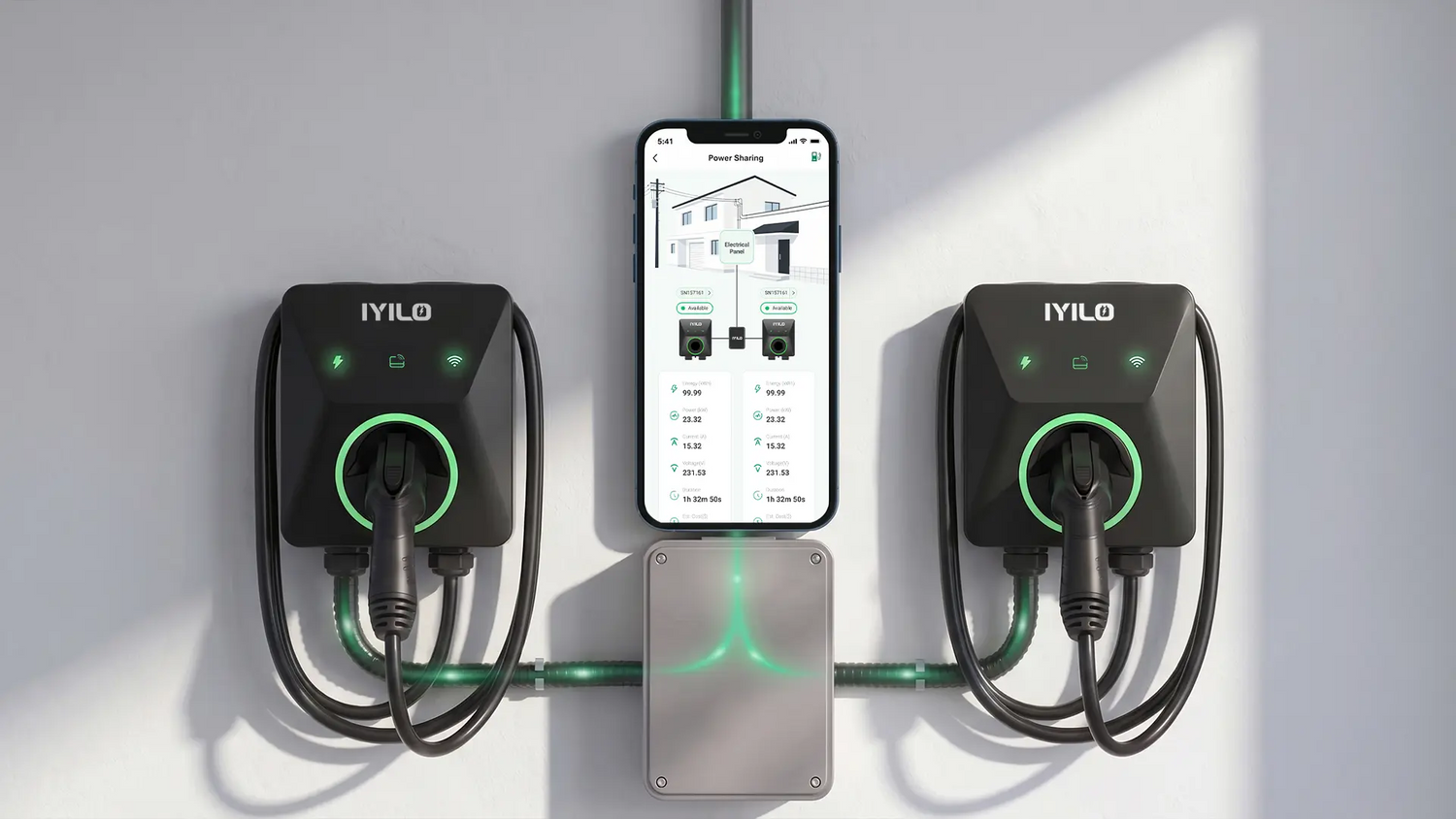
Level 2 chargers play a critical role in the daily routine of EV ownership. Today, consumers are more informed than ever, drawing from a wealth of readily available EV insights. Needless to say, a growing number of drivers are making the switch to electric to insulate themselves from the relentless volatility of gas prices. Along with the consumers’ EV demand ramp-up, the demand for multiple EVs within a single household has become quite common. Under these circumstances, charging two EVs at home at the same time has become a critical scenario to consider.
Let us understand a little bit about how home charging works before diving into today’s topic.
Here are the types of EV chargers for home charging:
Level 1 Charger: A low-kilowatt output charger, which can satisfy a certain group of consumers who need very few driving miles per day. Usually, a Level 1 Charger provides a maximum output of 1.92 kW and takes roughly 30 to 40 hours to fully charge an EV at home.
Level 2 Charger: Usually way faster than Level 1 charging. A home Level 2 charger operates at 208V to 240V and can fully charge an EV within 6 to 8 hours. The maximum output of 19.2 kW demonstrates just how powerful a Level 2 charger can be in a home charging environment.
What is power sharing?

Power Sharing (also known as Dynamic Load Balancing) is an intelligent energy management feature that allows multiple Level 2 chargers to safely share a single, fixed electrical circuit. Instead of overloading your home’s electrical panel or tripping the circuit breaker, the smart chargers communicate with each other in real-time to automatically and dynamically distribute the available current among all plugged-in EVs.
Key Requirements for Implementing Power Sharing:
1. A Shared Electrical Circuit and Panel
2. Smart Chargers with Communication Capabilities
3. A Unified Software Platform or Protocol
Key Use Cases for EV Power Sharing
The power-sharing function in a home or commercial charging scenario has become increasingly common. In fact, a lot of consumers now own more than one EV in their households. However, limited electrical capacity forces homeowners to find a seamless solution for charging multiple EVs simultaneously.
Here are several use case scenarios that possibly need power-sharing charging.
Overnight "Seamless" Charging for Multi-EV Households
This is the most common residential use case. As more North American families transition to owning two or more electric vehicles, manually swapping charging cables or setting middle-of-the-night alarms becomes a major hassle. With Power Sharing, homeowners can simply plug both EVs in before bed. The intelligent system automatically orchestrates a seamless power handover and distribution overnight, ensuring every vehicle is fully charged and ready for the morning commute.
Homes with Limited Electrical Capacity
Many older homes in North America are equipped with standard 100A or 150A electrical panels. Between running air conditioning, water heaters, and kitchen appliances, there is rarely enough remaining capacity to support two Level 2 chargers running at full power simultaneously. Power Sharing allows users to safely add a second charger to their existing infrastructure, completely eliminating the need for a costly electrical panel upgrade (which can run anywhere from $2,000 to $5,000).
Multi-Unit Dwellings (MUDs) & Multi-Family Housing
In apartments, townhouses, or condominiums, dedicating a separate, unmanaged high-power charging circuit to every single resident is often both physically and financially impossible due to grid limitations. Power Sharing serves as the perfect solution for multi-family communities. It creates an intelligent local charging network that dynamically schedules and routes power based on real-time vehicle demand and remaining battery capacities.
The Benefits of Power Sharing
Massive Financial Savings
In North America, residential households were built during different periods; therefore, their electrical infrastructure varies significantly. Many older homes, constructed in the 1980s, 1990s, or even earlier, feature a limited electrical service capacity of only 100A.
As a result, homeowners are often forced to spend thousands of dollars upgrading their main electrical panel. However, with Power Sharing technology, you can easily bypass these massive upgrade costs. Best of all, you won’t need to invest in extra hardware—like a higher-amp circuit breaker—or deal with unnecessary, complicated installations
Benefiting from the TOU Rate for both EVs
The biggest reason people buy an electric vehicle is to maximize their savings by charging overnight. However, consumers living in homes with limited electrical capacity often feel left behind, unable to take advantage of these lower night-time electricity rates. For families with two EVs, the savings are great, but the logistics can be a headache. Expecting someone to wake up in the middle of the night just to switch the charging cable from one car to another is completely impractical.
Smartly allocating the current.
An EVSE is far more than just a dumb pipe that delivers current from the grid to your car's onboard charger. Instead, a smart Level 2 charger acts as an intelligent energy manager. By constantly calculating power supply and demand, it leverages power sharing technology to distribute the precise amount of current each EV needs.
How does the IYILO Power Sharing function bring convenience to multi-EV owners?
The logic behind the IYILO Power Sharing Function
As a tech-oriented brand, IYILO is committed to engineering intelligent Level 2 chargers that solve real-world problems. Our Power Sharing feature was specifically developed to master the multi-EV charging dilemma.
Behind this feature is a smart, real-time logic designed to safely balance power based on each vehicle's actual acceptance rate.
Once Power Sharing is activated, the IYILO charger initiates a safe 6-amp baseline current to each vehicle. As the amperage ramps up, the charger intelligently senses the maximum charging capacity of each car, dynamically adjusting the current for optimal performance.
Here is how it works in practice: imagine you are on a dedicated 48-amp circuit. If both plugged-in EVs can accept 48 amps, Power Sharing will split the load equally, delivering 24 amps to each. However, if one vehicle tops out at 48 amps while the other only accepts 16 amps, the system will fully satisfy the lower-capacity car with its 16 amps first, and seamlessly channel the remaining 32 amps to the other vehicle
This dynamic adjustment logic ensures that every ounce of available power is utilized to its full potential. Furthermore, if one EV finishes charging early, the system seamlessly redirects the idle capacity to the remaining vehicle, unlocking its full charging speed. This intelligent strategy guarantees that both vehicles achieve peak charging performance, squeezing every bit of value out of your limited overnight off-peak window.
IYILO Power Sharing: Setup & Interface

Setting up Power Sharing is quick and easy using the IYILO App. For households looking to charge multiple EVs on a single circuit, you can explore our IYILO Dual-Charger Bundles here: https://iyilo.shop/collections/iyilo-dual-ev-charger-bundles
You can choose from three versatile combinations to best fit your vehicle needs:
Once your IYILO EV Chargers are successfully installed, you can configure the Power Sharing function by following these simple steps:
-
Access Settings: Open the IYILO App, navigate to Advanced, and tap on Power Sharing.
-
Configure Circuit Limits: Toggle the switch on to enable Power Sharing. Next, input the dedicated breaker rating and the maximum allowable current for that specific circuit.
3. Pair the Chargers: Add the two installed chargers to the group, save your settings, and the setup is complete!
The Power Sharing interface has been redesigned
The Power Sharing interface has been updated in App v1.2.10. You can now monitor two chargers on the same screen by following these steps:
-
Navigate to the main Charger screen. You will find a "Power Sharing dashboard" icon in the top-right corner.
-
Tap this icon to access the new Power Sharing interface.
On this page, you can view specific, real-time data for both chargers simultaneously.
The Ultimate Synergy: Combining Smart Features
with Power Sharing
While features like Scheduled Charging and TOU rate management offer incredible value for a single EV, their true potential is unlocked when combined with Power Sharing in a multi-EV household.
Imagine scheduling both of your vehicles to charge simultaneously during the cheapest off-peak window (e.g., 11:00 PM to 7:00 AM). Without smart load management, plugging in two cars at the same time could easily overwhelm your home's electrical panel and trip the circuit breaker.
However, when you integrate IYILO's Power Sharing with your customized TOU schedules—a synergy fully optimized in our latest App v1.2.0 and Firmware v1.3.22 updates—the system automatically takes over. The intelligent interface dynamically balances the electrical load between the two chargers. Both vehicles can charge concurrently within the most cost-effective time frame, automatically adjusting the current to ensure your home's circuitry remains perfectly safe.
This combination allows consumers to maximize their off-peak savings, enjoy a completely hands-off charging routine, and avoid the high costs of a home electrical panel upgrade.
0 comments