
You just installed a faster Level 2 charger, come home after a long workday, and the estimated charging time looks nearly the same as the older one. What happened? Level 2 charging speed isn't just about the charger on your wall. It's the result of three interconnected limits: your charger's amperage output, your EV's onboard AC charger capacity, and your home's electrical circuit. The slowest of the three wins — every time.
This guide cuts through the confusion with actual numbers, a real-world calculation method, and a practical framework for choosing the right home charging setup for your vehicle and home today.
Per the U.S. Department of Energy's AFDC charging guide, EV charging is classified as a continuous load — meaning your circuit breaker must be rated at 125% of the charger's amperage draw. A 40A charger needs a 50A breaker; a 48A charger requires a 60A breaker.
Level 2 Charging Speed by Amperage: Real Numbers
Level 2 uses 240V AC — the same voltage as a clothes dryer circuit. Power output is calculated as: kW = volts × amps ÷ 1,000. Here's what that means in practice at 240V, using an EV efficiency benchmark of 3.5 miles per kWh (a reasonable midpoint for most sedans and crossovers):
|
Amperage |
Power (kW) |
Miles/hr (3.5 mi/kWh) |
60 kWh 10→80% |
77 kWh 10→80% |
100 kWh 10→80% |
|
16A |
3.8 kW |
13–14 mi |
7.7 hr |
9.9 hr |
12.9 hr |
|
32A |
7.7 kW |
26–28 mi |
3.8 hr |
4.9 hr |
6.4 hr |
|
40A |
9.6 kW |
32–34 mi |
3.1 hr |
3.9 hr |
5.1 hr |
|
48A |
11.5 kW |
38–42 mi |
2.6 hr |
3.3 hr |
4.3 hr |
Times shown are net charging duration once plugged in, not wall-clock time from a cold state. Trucks and large SUVs achieving 2.5–3 mi/kWh will see proportionally longer times.
Key insight: For the majority of U.S. drivers covering 30–50 miles daily, a 40A or 48A charger can restore a full day's driving range in well under 4 hours — leaving plenty of overnight margin without any scheduling gymnastics.
Onboard Charger Limits by EV Model: The Factor Most Buyers Overlook
Your car's built-in AC-to-DC converter — called the onboard charger — is often the binding constraint on level 2 charging speed. Here's how common 2024–2026 models compare:
|
EV Model |
Max AC Accept |
Effective Speed |
Recommended Charger |
|
Tesla Model 3 RWD |
7.4 kW (~32A) |
~28 mi/hr |
32A–40A |
|
Tesla Model 3 LR / AWD |
11.5 kW (~48A) |
~40 mi/hr |
48A |
|
Tesla Model Y |
7.4–11.5 kW |
28–40 mi/hr |
40A–48A |
|
Chevy Equinox EV |
11.5 kW (48A) |
~38 mi/hr |
48A |
|
Ford F-150 Lightning |
19.2 kW (80A) |
~25–30 mi/hr† |
48A (max practical) |
|
Rivian R1T / R1S |
11.5 kW (48A) |
~30 mi/hr† |
48A |
|
Kia EV6 / Hyundai Ioniq 6 |
10.9 kW (~45A) |
~36 mi/hr |
48A |
|
BMW iX / i4 |
11 kW (~46A) |
~37 mi/hr |
48A |
* Varies by trim. † Lower mi/hr reflects lower efficiency (2.5–3 mi/kWh) on large trucks/SUVs — more kWh are delivered, but range per kWh is lower.
Checking your vehicle's AC charging specification before choosing charger amperage is the single most impactful step you can take. Spending more for a 48A charger when your EV tops out at 32A delivers zero additional speed.
Connector Type and Level 2 Charging Speed: J1772 vs. NACS
Since 2025, the North American Charging Standard (NACS, SAE J3400) has become the dominant connector on new EVs — used natively by Tesla, Ford, GM, Rivian, Honda, and others. Most Japanese and Korean brands still ship with J1772 as the primary port.
Important clarification: connector type does not affect Level 2 charging speed. Both J1772 and NACS support the same 240V AC power delivery. The connector simply determines physical compatibility — there's no electrical performance difference between them at Level 2 power levels.
• J1772: J1772 (SAE J1772): Standard on most non-Tesla EVs through 2024; widely compatible with public Level 2 stations
• NACS: Native on Tesla. Ford, GM, Rivian, and other major automakers (adapter support from 2024, native NACS on new EVs from 2025) rely on adapters for legacy J1772/CCS vehicles and stations.
IYILO offers both J1772 and NACS (J3400) versions of its Level 2 home chargers at 40A and 48A, so you can match your vehicle's native port without adapters — a detail worth confirming before ordering.

How to Calculate Your Actual Charging Time: A 3-Step
Method
Skip the guesswork. Use this straightforward calculation:
1. Find your EV's usable battery capacity (kWh). This is listed in your owner's manual or the manufacturer's spec sheet. Common values: 60 kWh (compact EV), 77–82 kWh (mid-size SUV), 100–131 kWh (truck/luxury).
2. Determine your charging window (kWh needed). Daily top-up: multiply usable capacity by 0.50 (50%). Deep recharge: multiply by 0.70 (10% to 80%). Full charge: multiply by 0.90 (10% to 100%).
3. Divide by your effective charging rate (kW). Use whichever is lower: your charger's kW output or your EV's onboard charger limit.
Worked Examples
Scenario A — Kia EV6 (77.4 kWh pack, 11 kW onboard, Level 2 at 11 kW):
77.4 × 0.70 ≈ 54 kWh needed ÷ 11 kW ≈ 4.9 hours for 10–80%. This is a theoretical estimate; Kia’s own figures are about 7 h 10 min for roughly 10–100% on an 11 kW AC charger.
Scenario B — Tesla Model 3 RWD (around 57.5 kWh pack, ~7–7.7 kW onboard) on a 40 A charger (up to 9.6 kW):
57.5 × 0.70 ≈ 40 kWh needed ÷ ~7–7.7 kW (vehicle limit) ≈ 5.5–5.8 hours for 10–80%. Here the car’s onboard charger, not the 40 A EVSE, is the main bottleneck.
Scenario C — Ford F‑150 Lightning Extended Range (131 kWh pack, ~11–11.5 kW onboard) on a 48 A charger (about 11.5 kW):
131 × 0.70 ≈ 92 kWh needed ÷ ~11–11.5 kW ≈ 8.0–8.4 hours for 10–80%. With a standard 48 A Level 2 unit, the practical limit is the truck’s onboard charger, even though some configurations can use up to 19.2 kW when paired with an 80 A home charging system.
In all three cases, charging typically slows once you move past about 80%, because the battery management system tapers current to protect the cells. If you often charge to 95–100%, it is reasonable to budget an extra 1–2 hours beyond the 10–80% estimates.
Plug-In vs. Hardwired: Does Installation Type Affect Level 2 Charging Speed?
Electrically, no — plug-in and hardwired installations deliver the same voltage and amperage if properly sized. The distinction affects installation flexibility, portability, and maximum possible amperage in some jurisdictions.
|
Factor |
Plug-In (NEMA 14-50) |
Hardwired |
|
Max amperage (typical) |
40A continuous (50A breaker) |
48A continuous (60A breaker) |
|
Speed difference |
None if same amperage |
Marginal advantage at 48A only |
|
Portability |
Can move if you relocate |
Permanent — needs electrician to move |
|
Installation complexity |
Lower — outlet pre-existing |
Higher — direct wire to panel |
|
Recommended for |
Renters, first-time EV owners |
Owners with long-term plans, 48A EVs |
IYILO's lineup covers both approaches: plug-in models at 40A (NEMA 14-50, J1772 or NACS) and hardwired models at 48A for maximum Level 2 speed — including the IYILO Pro with a built-in energy meter for precise session-by-session electricity cost tracking.
Additionally, IYILO also has a unique SKU:48Amp Plug-In, which has a factory default setting of 40 amps with a NEMA14-50 Plug. When you need to upgrade the wiring method from Plug-In to Hardwire for maximum charging, simply switch the input plug cable to a hardwired installation and adjust the dip switch from 40A to 48A internally to reach the highest power capacity.
Dynamic Load Balancing and Level 2 Charging Speed
at Home
Home electrical panels — typically rated 100A or 200A — must serve your entire house simultaneously. When your HVAC, electric dryer, and EV charger all draw power at once, the combined load can trip a breaker or require an expensive panel upgrade.According to the U.S. Department of Energy's Alternative Fuels Data Center, electricians should assess available panel capacity before any EV charger installation to avoid overloads.
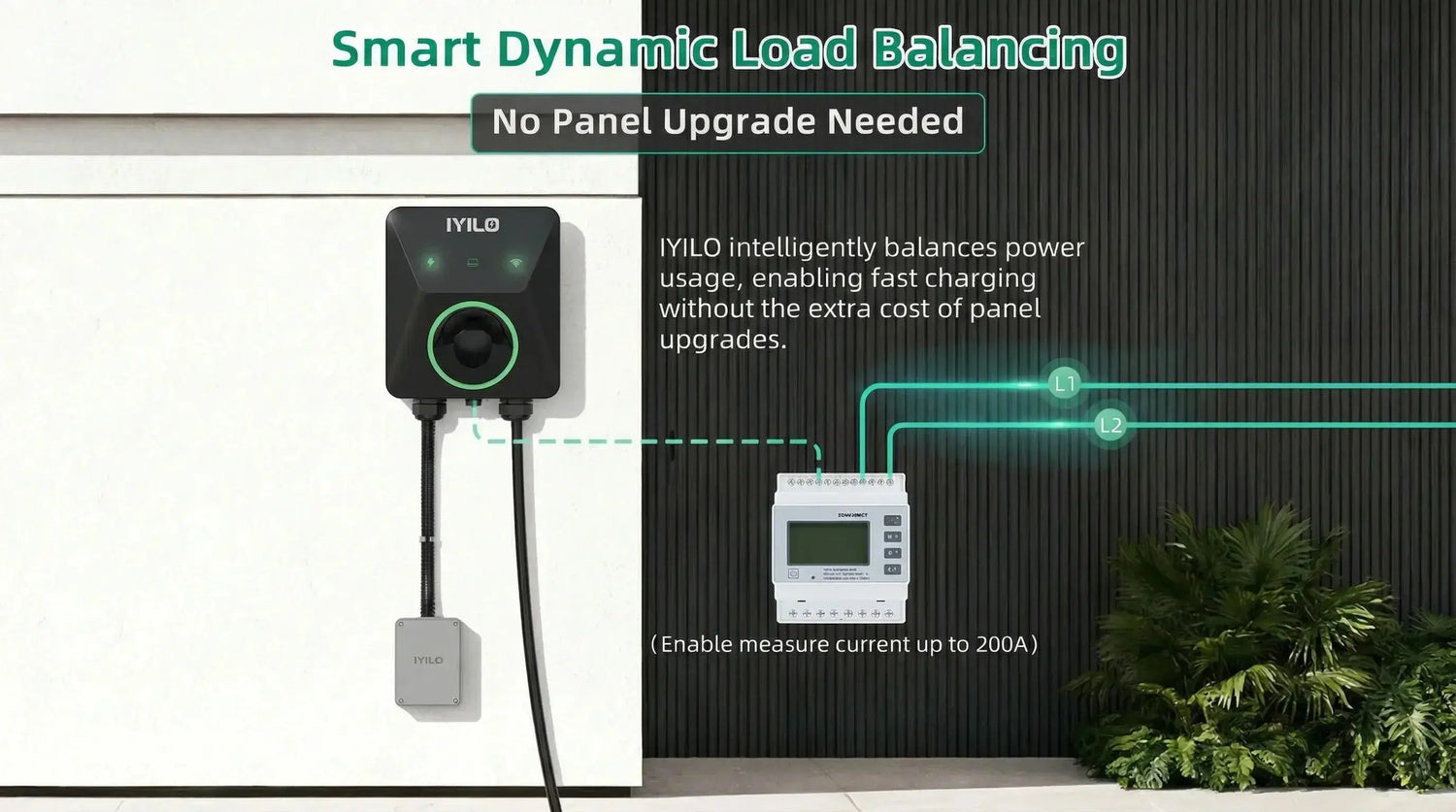
Dynamic load balancing solves this without hardware upgrades. A smart charger monitors your home's real-time total draw and automatically reduces EV charging current during peak household usage — then ramps back up when demand drops. The result: you get the fastest possible Level 2 charging speed your panel allows at any given moment, without overloading the system.
IYILO's dynamic load balancing (available on Pro models) works in concert with the IYILO app to give you visibility into real-time charging power, session history, and energy cost tracking — so you're never guessing what your charger is actually delivering. Independent EV reviewer Tom Moloughney of State of Charge noted in his full IYILO review that the intelligent load management feature allows installation on high-powered circuits even where home service capacity would otherwise be a constraint.
Specifically, IYILO utilizes RS-485 hardwiring with a dedicated energy meter to achieve Dynamic Load Balancing (DLB). Unlike wireless alternatives, the RS-485 connection maximizes reliability and completely eliminates the risk of signal drops associated with Wi-Fi.
Moreover, IYILO goes beyond simple residential setups. To address the growing needs of multi-EV households, we conducted in-depth user research to develop our advanced Power Sharing feature. This function allows two IYILO Chargers to safely share a single dedicated circuit breaker while intelligently allocating current between them
Power sharing: Two IYILO chargers on a shared 50A circuit can split available amperage dynamically — each charging at 20–24A when both cars are plugged in, then ramping to the full allocation when one completes.
Level 2 at Home vs. Public Stations: Speed
Comparison
A common misconception: public Level 2 chargers are faster than home units. In practice, the same physics apply — both use 240V AC, and your vehicle's onboard charger remains the ceiling regardless of location.
|
Home Level 2 |
7.7–11.5 kW |
Overnight (6–10 hr) |
Daily charging, off-peak rates |
|
Public Level 2 |
6.2–19.2 kW |
2–6 hr while parked |
Workplace / destination charging |
|
DC Fast (Level 3) |
50–350 kW |
20–45 min |
Road trips, emergency top-ups |
The practical home charging advantage isn't speed — it's cost and convenience. The DOE's AFDC home charging resource notes that overnight Level 2 charging using time-of-use electricity rates (available in most U.S. utility territories) typically costs far less per mile than public DC fast charging. Over 12 months, that savings gap compounds significantly for daily drivers.
Choosing the Right Level 2 Charging Speed for Your Home
Use this decision framework to match charger amperage to your real situation:
|
PHEV / small EV, <25 mi/day |
16–32A |
20A–40A |
32A Plug-In (J1772) |
|
Typical commuter, 25–60 mi/day |
40A |
50A |
40A Plug-In (J1772 or NACS) |
|
High-mileage or large EV (>60 mi/day) |
48A |
60A |
48A Hardwired (J1772 or NACS) |
|
Multi-EV household, constrained panel |
48A + load balancing |
60A (shared) |
IYILO Pro 48A Hardwired |
Future-proofing tip: Even if your current EV tops out at 32A, running 6 AWG copper wire and a 60A breaker at installation adds minimal cost and fully supports a 48A charger when you upgrade your vehicle. Retrofitting wiring later is significantly more expensive. The NFPA's 2024 overview of NEC requirements for EV charger installations is a useful resource to share with your electrician before any installation.
Frequently Asked Questions About Level 2 Charging Speed
Q: Will a 48A charger charge my car faster than a 40A charger?
Only if your vehicle's onboard charger supports more than 9.6 kW. If your EV is capped at 7.2 kW (as many Tesla RWD models are), both chargers will deliver the same rate — the vehicle's internal limit is the bottleneck.
Q: Does Level 2 charging speed vary by time of day?
Not inherently. However, if your home electrical panel is near capacity during peak hours and your charger uses dynamic load balancing, the charger may temporarily reduce output to prevent overloading. Smart chargers like those in IYILO's lineup can also be scheduled to charge at off-peak hours for lower electricity costs.
Q: What's the difference between Level 2 and DC fast charging (Level 3) speed?
Level 2 delivers AC power that your vehicle converts internally — maximum ~19.2 kW for home applications. DC fast charging bypasses the onboard charger entirely and delivers power directly to the battery at 50–350 kW. For daily home use, Level 2 is sufficient for most drivers. DC fast charging is best reserved for road trips and urgent top-ups.
Q: Does a hardwired charger charge faster than a plug-in charger?
Only if the hardwired unit operates at a higher amperage. A hardwired 48A charger on a 60A breaker outperforms a plug-in 40A charger on a 50A breaker by roughly 20% in kW output. If both are at the same amperage, the charging speed is identical.
Q: How do I know if my home panel can support a Level 2 charger?
Have a licensed electrician calculate your panel's available headroom after existing loads (HVAC, water heater, dryer, etc.). Most 200A service homes can support a 40A or 48A EV charger without upgrades. 100A service homes may require load management or a panel upgrade for larger chargers.
Q: Is the IYILO charger Energy Star certified?
Yes. IYILO's Level 2 home chargers carry ENERGY STAR certification alongside ETL and FCC approvals. ENERGY STAR certified Level 2 AC chargers use 40% less energy in standby mode
Conclusion: Speed Is a System — Build It Right
Level 2 charging speed isn't a single number — it's the outcome of a three-way interaction between your charger, your vehicle, and your home's electrical capacity. Understanding which of the three is your actual limiting factor is what allows you to invest in the right equipment and get real performance improvement.
For most North American households — driving 30–60 miles daily in a modern EV — a 40A or 48A Level 2 charger delivers all the speed you need, with enough overnight margin to wake up to a full battery every morning. The IYILO lineup, ETL and Energy Star certified, covers the full range from 40A plug-in to 48A hardwired and the feature-rich IYILO Pro — with dual NTC temperature sensors, dynamic load balancing, and IYILO app integration built in.
Electrify your journey — starting with the right charger, properly matched to your EV and your home.
0 comments